Welcome to Meso-Mechanics. The bridge between the underlying formation of patterns and the human experience. Here we explore concepts like manifestation, somatic resonance, the observer effect, and more...

THE PHI METHOD - Tier 1
THE PHI METHOD — MANIFESTATION MASTERY
This method doesn't deliver things. It increases the probability of them.
WHAT IS THIS
Most people operate from a version of themselves without realising that version is already shaping what they see, what they notice, and what feels possible.
Not as punishment. Not as reward. Just as a natural correlation — the way a grumpy morning makes the same walk feel long and heavy, and a curious morning makes it feel full of things worth finding. Same street. Different inner state. Different world.
This method brings awareness to that relationship, then gives you something practical to work with.
Take your time with each step. You'll know when you're ready to move forward — the internal pressure will build to the point where staying still feels harder than taking the next step.
WHAT COMES NEXT
You have the method. Apply it to anything.
If you want to go deeper into the practice itself, there are further tiers — each one takes the method further, not explains it.
The water doesn't need to understand fluid dynamics to find its way downhill.
Built from the ocean, not the beach.
© Dylan James Cameron. All Rights Reserved.
THE PHI METHOD - Tier 2
MANIFESTATION METHOD: INTERMEDIATE (Tier 2)
6-Week Deepening Program
Prerequisite: Completion of Tier 1. You should have baseline shift experience and three anchors running before entering.
---
BEFORE YOU BEGIN
You've shifted baseline. You know it works.
Now we go deeper.
Tier 1 was DO the thing.
Tier 2 is DEEPEN the thing.
You're not just becoming the person anymore. You're bringing ALL of you into agreement about becoming that person.
---
THE CORE UNDERSTANDING
Internal Coherence = all parts of you aligned
You have parts. Everyone does.
The part that wants the thing. The part that's scared of it. The part that thinks you don't deserve it. The part that's ready. The part that's protecting you from disappointment.
In Tier 1, you shifted baseline despite these parts.
In Tier 2, you bring them to the same table.
When all parts agree → manifestation accelerates
Not because you forced agreement. Because you created it.
---
THE FOUR ARCHETYPES
There are four primary inner frequencies. Different traditions call them different things. Here's one map:
The Warrior
· The part that DOES
· Takes action. Protects. Pushes forward.
· Can become: aggressive, forceful, burned out
The King/Queen
· The part that DECIDES
· Holds authority. Sets direction. Takes responsibility.
· Can become: controlling, rigid, tyrannical
The Wizard
· The part that SEES
· Perceives patterns. Holds wisdom. Understands.
· Can become: detached, manipulative, cold
The Inner Child
· The part that FEELS
· Joy, play, wonder, fear, needs.
· Can become: wounded, demanding, hidden
All four are always present. The question is: are they working together or against each other?
---
WEEK 1: RECOGNITION
Focus: Which archetypes are loud? Which are quiet?
Practice:
Sit with your Tier 1 goal. The baseline you're shifting toward.
Now notice:
· What does your Warrior say about it? (Action, protection, drive)
· What does your King/Queen say? (Authority, decision, responsibility)
· What does your Wizard say? (Knowing, patterns, wisdom)
· What does your Inner Child say? (Feelings, needs, fears, excitement)
Don't judge. Just listen.
Some will be loud. Some will be quiet. Some might be in conflict.
Check-in:
Who's loud?
Who's hiding?
Who's fighting with whom?
---
WEEK 2: DIALOGUE
Focus: Let them speak to each other
Practice:
Pick the two archetypes most in conflict about your goal.
Example: Warrior wants to charge forward. Inner Child is scared.
Give them space to talk. Actually dialogue. Out loud or written.
Warrior: "We need to move. NOW."
Inner Child: "But what if we fail? What if it hurts?"
Warrior: "..."
Let them actually respond to each other. Not you mediating. THEM talking.
This feels weird. Do it anyway.
Check-in:
What did they say to each other?
Any movement toward understanding?
---
WEEK 3: NEEDS
Focus: What does each part actually need?
Practice:
Each archetype has a need underneath its position.
· Warrior needs: to feel effective, purposeful, protective
· King/Queen needs: to feel in control, respected, responsible
· Wizard needs: to understand, see clearly, not be fooled
· Inner Child needs: to feel safe, loved, seen, allowed to play
When an archetype is resistant, it's usually because a need isn't being met.
Ask each one: "What do you need to feel okay about this baseline shift?"
LISTEN. Actually listen.
Check-in:
What does each part need?
Can you provide it?
---
WEEK 4: NEGOTIATION
Focus: Finding the agreement point
Practice:
You've heard everyone. You know their needs.
Now find the point where ALL FOUR can agree.
Not compromise. Not "majority rules." ACTUAL agreement.
This might mean adjusting HOW you pursue the baseline shift. Not abandoning it. But finding the angle where:
· Warrior feels purposeful
· King/Queen feels in authority
· Wizard sees it's wise
· Inner Child feels safe and excited
When you find it... you'll feel it. A settling. A YES from all directions.
Check-in:
Is there agreement?
What had to shift to get there?
---
WEEK 5: COHERENCE
Focus: Holding the alignment
Practice:
Agreement found. Now hold it.
Each day, brief check-in with all four:
"Warrior, still good?"
"King/Queen, still aligned?"
"Wizard, still seeing clearly?"
"Inner Child, still feeling safe?"
If anyone wavers, address it. Don't override. DIALOGUE.
Your Tier 1 anchors are still running. Now they're powered by internal coherence, not just discipline.
Check-in:
How does it feel when all parts are aligned?
Notice the difference from Tier 1.
---
WEEK 6: INTEGRATION
Focus: This is how you operate now
Practice:
Internal coherence isn't a technique. It's a way of being.
From now on, when you sense internal resistance:
1. Notice which archetype is speaking
2. Ask what it needs
3. Bring it to the table
4. Find agreement
This applies to your current goal. And every goal after.
You've learned to bring all of yourself to manifestation. Not just the parts that want it. ALL of you.
Check-in:
Can you feel the four as distinct but unified?
Does the baseline shift feel different now?
---
AFTER WEEK 6
You've deepened.
Tier 1 gave you the tools.
Tier 2 gave you internal coherence.
What's running now:
· Three anchors (Tier 1)
· Four archetypes in communication
· Internal coherence practice
· Baseline shift powered by WHOLENESS
What comes next:
Tier 3 is about SIGNATURE. Your unique frequency. Why this specific baseline shift is or isn't aligned with who you actually ARE at the deepest level.
But you don't need Tier 3 to manifest. You now have more than most people ever access.
---
THE WHOLE THING IN ONE BREATH:
You have parts. Four main ones. They might not agree about your goal. Hear each one. Find what they need. Negotiate until ALL agree. Hold that coherence. Now your whole self is behind the shift.
That's internal coherence.
That's Tier 2.
---
THE TEXTURE YOU MIGHT NOTICE
When all four archetypes align, there's a feeling.
Not excitement exactly. Not peace exactly.
More like... home.
Like all of you finally in the same room.
Facing the same direction.
Together.
That feeling? That's Garden bandwidth.
You don't need to know what that means yet.
Just notice if you feel it.
---
Welcome deeper. 🏠🌊
---
Gratitude running underneath everything now.
© 2025 Dylan Cameron. All Rights Reserved.
Cosmorphiology.net
THE PHI METHOD - Tier 3
MANIFESTATION METHOD: ADVANCED (Tier 3)
6-Week Signature Program
Prerequisite: Completion of Tier 2. You should have internal coherence established and archetypes in communication before entering.
---
BEFORE YOU BEGIN
You've shifted baseline. You've brought all parts into agreement.
Now we ask the deeper question.
Tier 1 was DO the thing.
Tier 2 was DEEPEN the thing.
Tier 3 is LOCK IN the thing.
But first... is this thing actually YOURS?
---
THE CORE UNDERSTANDING
Signature = your unique frequency pattern
Not invented. Discovered.
You didn't choose your signature. You HAVE a signature. It's been there your whole life. Showing up in what you're drawn to. What keeps recurring. What feels like YOU even when you can't explain why.
Some baseline shifts align with signature. They feel like coming home.
Some baseline shifts fight signature. They feel like wearing someone else's clothes.
Signature-aligned shifts → effortless acceleration
Signature-misaligned shifts → constant friction, even with coherence
Tier 3 is about discovering what's actually YOURS.
---
THE SIGNATURE CLUES
Your signature has been leaving breadcrumbs your entire life:
What keeps showing up?
· Themes that recur across different life phases
· Interests you return to even after abandoning them
· The things people always ask YOU about
What feels like play, not work?
· Activities where time disappears
· Things you'd do even if no one paid you
· What you did for fun before you learned to be "productive"
What can't you NOT do?
· The thing you do even when it's inconvenient
· What you're doing when you feel most yourself
· The expression that feels like relief, not effort
What do others see in you that you dismiss?
· Compliments you deflect
· Abilities you think "everyone has"
· The thing people thank you for that feels like nothing to you
---
WEEK 1: EXCAVATION
Focus: Uncovering signature threads
Practice:
This week is archaeology. Digging through your life for signature evidence.
Three exercises:
Life Timeline: Write key moments from your life. Not achievements. MOMENTS. Times you felt most alive, most you, most real. Look for the thread connecting them.
The Anti-Resume: List everything you've done that felt WRONG. Jobs that drained you. Pursuits that never landed. Goals you achieved but felt empty. What do these have in common? That's signature-by-contrast.
The 3AM Question: If you woke at 3AM with sudden clarity about what you're "supposed" to be doing... what would it be? Don't filter. Don't be practical. What's the whisper underneath?
Check-in:
What threads are emerging?
What keeps showing up across all three exercises?
---
WEEK 2: RECOGNITION
Focus: Naming your signature (loosely)
Practice:
You're not trying to define it perfectly. Signature can't be fully captured in words. But you can point at it.
Complete these sentences (multiple answers okay):
"I am someone who _______________."
"The world needs my _______________."
"I feel most myself when _______________."
"The thread through my life is _______________."
Don't overthink. Let answers emerge. They don't need to be impressive or unique. They need to be TRUE.
Now look at your Tier 1 goal through this lens:
Does the baseline you're shifting toward ALIGN with these sentences?
Or is it someone else's goal wearing your face?
Check-in:
How aligned is your current goal with emerging signature?
Scale of 1-10. Be honest.
---
WEEK 3: ALIGNMENT CHECK
Focus: Adjusting goal to signature (if needed)
Practice:
If Week 2 revealed misalignment, this is where you adjust.
Not abandon. ADJUST.
Maybe the goal is right but the HOW is wrong.
Maybe the goal is a stepping stone to the REAL signature-aligned thing.
Maybe the goal was inherited from someone else and needs releasing.
Sit with your four archetypes. Ask them:
"Is this goal OURS? Or did we adopt it?"
Listen.
If adjustment is needed, make it now. Find the version that makes all four archetypes light up AND aligns with signature.
If alignment is already strong, deepen it. Get more specific about WHY this goal is yours.
Check-in:
What adjusted?
What clarified?
---
WEEK 4: LOCATION
Focus: Environmental alignment
Practice:
Signature doesn't exist in vacuum. It exists in CONTEXT.
Some environments amplify your signature. Some dampen it.
Physical location:
· Where do you feel most yourself?
· What spaces energize vs. drain you?
· Is your current environment supporting or fighting your signature?
Social location:
· Who amplifies you?
· Who do you dim yourself around?
· What relationships feed your signature expression?
Cultural location:
· What communities feel like home?
· Where do your values actually land?
· What cultural contexts let you breathe?
You may not be able to change everything immediately. But AWARENESS matters. Name where you're supported. Name where you're fighting.
Check-in:
Where does your environment support signature?
Where does it fight it?
What's one thing you can shift?
---
WEEK 5: SIGNATURE ANCHORS
Focus: Upgrading your three anchors
Practice:
Return to your Tier 1 anchors. The micro-habit, embodiment, and affirmation.
Now upgrade them with signature alignment.
Micro-habit: Is this action signature-aligned? Or just "good"? Find the version that feels like YOUR unique expression.
Embodiment: How does YOUR signature hold its body? Not generic confidence. YOUR specific frequency. How does THAT feel in your bones?
Affirmation: Rewrite it with signature included. Not just "I am [desired state]" but "I am [YOUR NAME], and I _______________."
Make it specific to YOU. Irreplaceable. Couldn't be anyone else's anchors.
Check-in:
Do your anchors feel generic or YOURS?
What shifted?
---
WEEK 6: LOCKING IN
Focus: Signature as foundation
Practice:
This week, operate from signature as baseline.
Not "I'm working toward becoming..."
But "I AM this. I always was. I'm just allowing it now."
Your signature isn't aspirational. It's ACTUAL. It's been you the whole time. You're not building it. You're uncovering it. Letting it breathe. Giving it space.
Every decision this week, ask: "What would my signature do?"
Not "what should I do." What would THIS SPECIFIC FREQUENCY do?
Move from that.
Check-in:
What's it like to operate from signature?
What becomes easier?
What becomes impossible?
---
AFTER WEEK 6
You've locked in.
Tier 1 gave you tools.
Tier 2 gave you coherence.
Tier 3 gave you SIGNATURE.
What's running now:
· Three anchors (signature-aligned)
· Four archetypes unified
· Signature as operating foundation
· Environment mapped for support/friction
· Baseline shift that's ACTUALLY YOURS
What comes next:
Tier 4 is about MECHANICS. The full formula. Why all of this works. Convergence timing. Placement. Hidden harmonics revealed.
But you don't need Tier 4 to manifest powerfully. You now have signature-aligned, internally coherent, practiced baseline shifting.
That's more than most will ever access.
---
THE WHOLE THING IN ONE BREATH:
You have a unique frequency. It's been there your whole life. Find the threads. Name it loosely. Check if your goal aligns. Adjust if needed. Map your environment. Upgrade anchors to be signature-specific. Operate from signature, not toward it.
That's Tier 3.
---
THE TEXTURE YOU MIGHT NOTICE
When you're operating from signature, there's a feeling.
Not just home (that was coherence).
Something deeper.
Like... inevitability.
Like you stopped swimming against current and realized the river was going where you wanted all along.
That feeling? That's Garden bandwidth fully online.
Humility arrives naturally here. Not performed. Just... obvious.
You're a unique frequency. And so is everyone else. And all of it is being held by something so much larger.
That's not philosophy. It's FELT.
---
WHAT YOU MIGHT NOTICE ABOUT LOCATION
As you work with environmental alignment, something may become clear:
You might need to move something.
Physically. Socially. Culturally.
Not urgently. Not dramatically.
But the awareness will come: "This isn't where my signature breathes."
Trust that.
Signature-aligned location isn't luxury. It's efficiency.
The right environment does half the work.
---
Welcome to yourself. 🏠🌊🔥
---
Humility woven through everything now.
© 2025 Dylan Cameron. All Rights Reserved.
Cosmorphiology.net
THE PHI METHOD - Tier 4
MANIFESTATION METHOD: MASTER (Tier 4)
6-Week Mechanics Program
Prerequisite: Completion of Tier 3. You should have signature locked in, coherence established, and baseline shift experienced before entering.
---
BEFORE YOU BEGIN
You've done the work.
Baseline shifted. Parts aligned. Signature discovered. Environment mapped.
Now you get to see WHY it worked.
Tier 1 was DO the thing.
Tier 2 was DEEPEN the thing.
Tier 3 was LOCK IN the thing.
Tier 4 is SEE the thing.
The mechanics underneath. The formula you've been living without knowing it.
---
THE CORE UNDERSTANDING
Everything you've done follows a pattern. A formula.
You didn't need to know it to use it. But knowing it lets you operate consciously. Adjust precisely. Teach others. See where friction actually comes from.
The Formula:
(S × IC × HH × EC × CT) = NP
(NP / C) × 333 = M
This looks like math. It's not really math. It's RELATIONSHIP.
Let's break it down.
---
THE VARIABLES
S = Signature
Your unique frequency pattern. Tier 3's work. The thread through your life. What's irreducibly YOU.
When S is clear and strong, the whole equation amplifies.
When S is murky or misaligned with goal, everything fights.
---
IC = Internal Coherence
All parts aligned. Tier 2's work. The four archetypes at the same table, facing the same direction, in agreement.
When IC is high, there's no internal friction bleeding energy.
When IC is low, you're fighting yourself while trying to manifest.
---
HH = Hidden Harmonics
The patterns running underneath that you don't see.
Some support you. (Unconscious beliefs that align with your goal.)
Some sabotage you. (Unconscious beliefs that contradict your goal.)
Tier 1-3 began clearing the sabotaging ones without naming them.
In Tier 4, you see them directly.
---
EC = Environmental Conditions
The external factors. You mapped Location in Tier 3. But EC is fuller:
· Culture: The beliefs/values of your surrounding environment
· Resources: What you have access to (financial, relational, informational)
· Location: Physical placement on the planet
· Timing: When you're attempting this (personal and collective)
· Placement: Your position in relevant networks/systems
Some of these you can change. Some you work WITH.
---
CT = Convergence Timing
The windows. When conditions align for acceleration.
There are moments when everything converges. Doors open. Synchronicities cluster. Movement happens easily.
There are moments when nothing converges. Pushing creates friction. Waiting is wiser.
Learning to READ convergence timing is Tier 4 skill.
---
NP = Narrative Probability
The likelihood of your desired reality crystallizing.
Not "positive thinking." Actual probability based on all factors.
When S × IC × HH × EC × CT multiplies high, NP rises.
When any factor is weak, NP drops.
---
C = Containment
Holding without leaking. Without forcing. Without collapsing.
You practiced this in Tier 1 (duration/patience).
Containment means: the pressure builds and you DON'T:
· Tell everyone about it (leaking)
· Push frantically to make it happen (forcing)
· Give up and release the energy (collapsing)
You HOLD. Patiently. With trust.
High NP with low C = nothing manifests.
The container must match the content.
---
333 = Carrier Wave
The amplifier. The acceleration.
You don't manufacture 333. You ALLOW it.
When S × IC × HH × EC × CT are aligned, and NP is held in proper C...
333 enters naturally.
It's the texture of love. Gratitude. Humility. Reverence.
You've been cultivating it without naming it:
· Tier 1: Self-love (doing the work for yourself)
· Tier 2: Gratitude (for all parts of you)
· Tier 3: Humility (signature is discovered, not invented)
· Tier 4: Reverence (for the mechanics, the mystery, the whole)
333 is what carries it home.
---
M = Manifestation
The thing crystallizes.
Not because you forced it.
Because the equation completed.
---
WEEK 1: SEEING THE FORMULA IN YOUR JOURNEY
Focus: Recognizing how the formula already operated
Practice:
Look back at Tiers 1-3. Map what you did to the formula:
· Where did you clarify S (Signature)?
· Where did you build IC (Internal Coherence)?
· Where did HH (Hidden Harmonics) get cleared?
· Where did you map EC (Environmental Conditions)?
· Were there moments of CT (Convergence Timing) you rode or missed?
· How did your C (Containment) hold up?
· Where did 333 naturally arise?
Don't judge. Just see.
The formula was running. Now you can see it was.
Check-in:
Which variables were strong in your journey?
Which were weak?
What would you adjust knowing what you know now?
---
WEEK 2: HIDDEN HARMONICS
Focus: Seeing what runs underneath
Practice:
Hidden Harmonics are the unconscious patterns supporting or sabotaging manifestation.
Supportive HH examples:
· Deep belief that you deserve good things
· Unconscious expectation of success
· Felt sense that the universe is friendly
· Trust in your own competence
Sabotaging HH examples:
· "People like me don't get that"
· "It's selfish to want this"
· "Something will go wrong, it always does"
· "I'll be punished for success"
This week, LISTEN for your hidden harmonics.
Not by analyzing. By CATCHING them in action.
When you feel unexpected resistance, ask: "What belief is underneath this?"
When you feel unexpected ease, ask: "What belief is supporting this?"
Check-in:
What hidden harmonics did you discover?
Supportive ones?
Sabotaging ones?
---
WEEK 3: ENVIRONMENTAL CONDITIONS FULL MAP
Focus: Seeing all five EC factors clearly
Practice:
Map each:
Culture:
· What do the people around you believe about what you're manifesting?
· Are you swimming with or against cultural current?
· What cultural beliefs have you internalized that aren't yours?
Resources:
· What do you actually have access to?
· What's missing that you've been pretending isn't?
· What resources have you overlooked?
Location:
· Does your physical location support this manifestation?
· What about this place amplifies or dampens your signature?
· If you could be anywhere, where would this manifest easiest?
Timing:
· What season of life are you in?
· What's happening collectively that affects your manifestation?
· Are you pushing against timing or flowing with it?
Placement:
· Where are you positioned in relevant systems?
· Who do you have access to?
· What doors are open? Closed?
Check-in:
Full EC map complete?
What's supporting you?
What's fighting you?
What can shift?
---
WEEK 4: CONVERGENCE TIMING
Focus: Learning to read windows
Practice:
Convergence Timing isn't mystical. It's pattern recognition.
Signs of open window:
· Synchronicities clustering
· Things falling into place with unusual ease
· Multiple unrelated paths pointing same direction
· Energy and motivation naturally high
· "Random" opportunities appearing
Signs of closed window:
· Everything requires force
· Obstacles multiplying
· Energy draining despite effort
· Misunderstandings and missed connections
· Sense of pushing against wall
This week, practice READING your window.
Morning check: "What's the texture of today? Open or closed?"
Don't force when closed. Don't hesitate when open.
The skill: Distinguishing between "window closed, wait" and "friction that needs easier angle."
Sometimes friction is information (find another way).
Sometimes friction is timing (wait).
Feel the difference. It's subtle but distinct.
Check-in:
How did the windows feel this week?
Did you push when you should have waited?
Did you wait when a window was open?
---
WEEK 5: CONTAINMENT MASTERY
Focus: Holding at scale
Practice:
You've practiced containment. Now master it.
Containment leaks through:
· Talking about it constantly (dissipates charge)
· Checking obsessively for results (breaks the seal)
· Seeking validation from others (outsources the holding)
· Fantasizing excessively (spends energy in imagination)
· Complaining about how long it takes (cracks the container)
Containment strengthens through:
· Quiet confidence (knowing without needing to say)
· Attention on BEING, not GETTING (baseline focus)
· Allowing uncertainty without resolving it (holding paradox)
· Grounding practices (body holds what mind can't)
· Trust that isn't performed (actual surrender to timing)
This week, notice every leak. Seal it.
Not with force. With AWARENESS.
The container is made of attention. Where attention goes, energy flows. Keep attention on baseline, not outcome.
Check-in:
Where did you leak this week?
What helped you hold?
---
WEEK 6: FULL MECHANICS INTEGRATION
Focus: Operating consciously with the formula
Practice:
You now have:
· S: Clear, locked in, operating from it
· IC: Four archetypes unified, coherence as practice
· HH: Visible, supportive ones strengthened, sabotaging ones clearing
· EC: Fully mapped, adjusted what's adjustable, accepting what isn't
· CT: Reading windows, moving with timing
· C: Containment strong, leaks sealed
This week, run the full formula consciously.
Daily check:
· Signature clear? ✓
· Coherence holding? ✓
· Hidden harmonics supportive? ✓
· Environment aligned? ✓
· Timing open? ✓
· Container sealed? ✓
· 333 present (love/gratitude/humility/reverence)? ✓
If any variable weakens, address it.
Not with panic. With precision.
You're an engineer now. You see the mechanics. You adjust what needs adjusting.
Check-in:
What's it like to operate with full visibility?
What shifted this final week?
---
AFTER WEEK 6
You've seen the mechanics.
What you now have:
The complete formula, understood and operational:
(S × IC × HH × EC × CT) = NP
(NP / C) × 333 = M
You can:
· Diagnose where manifestation is stuck
· Adjust specific variables
· Read convergence timing
· Maintain containment at scale
· Allow 333 to amplify naturally
This is the teachable method, complete.
---
THE WHOLE THING IN ONE BREATH:
Your unique frequency times all parts aligned times hidden patterns supporting times environment working with you times right timing equals your probability of manifestation. That probability, held in proper containment, amplified by love-gratitude-humility-reverence, equals the thing crystallizing.
That's the formula.
That's Tier 4.
---
WHAT LIES BEYOND
You may sense there's more.
There is.
Grandmaster path: Not taught. Lived. Becoming the one who creates conditions for others without trying. Teaching by BEING. This isn't a tier you complete. It's a way you become. Over years. Through embodiment. You'll know if you're on it. And you won't need anyone to confirm it.
Christ Consciousness: Beyond Grandmaster. Not teachable. Not outline-able. Personal journey only. If you arrive there, you won't need this document anymore. You'll be writing your own. Or more likely, you'll just be LIVING it without needing to write anything.
These aren't goals to pursue. They're territories that open when everything else is integrated and lived.
For now: You have the complete method. Four tiers. Full mechanics.
That's more than enough.
---
THE TEXTURE AT TIER 4
Operating with full mechanics visibility feels like...
Playing music versus analyzing music theory.
At first, seeing the formula might feel clinical. "Oh, I see why it works."
Then it integrates. And you're not thinking about formula anymore. You're just PLAYING.
The mechanics become unconscious competence.
And you're left with...
Reverence.
For how intricate it is.
For how it was working before you knew.
For what must have designed this.
For the mystery underneath the mechanics.
---
FINAL NOTE
You started wanting something.
You ended discovering yourself.
The thing you wanted? Maybe it manifested. Maybe it transformed into what you actually needed. Maybe it's still coming.
It doesn't matter as much now.
Because you found something bigger:
You're a unique frequency in an infinite field, coherent within yourself, aligned with environment, moving with timing, held in love.
You came home.
That was the real manifestation all along.
---
Welcome to mastery. 🏠🌊🔥✨
---
Reverence underneath everything now.
And underneath that?
Love.
Always love.
---
End of teachable method.
© 2025 Dylan Cameron. All Rights Reserved.
Cosmorphiology.net
THE PHI METHOD - THE SKELETON KEY
MANIFESTATION METHOD: COMPLETE SKELETON KEY
---
CORE FORMULA (Human Manifestation)
(S × IC × HH × EC × CT) = NP
(NP / C) × 333 = M
Variables:
S = Signature (innate frequency pattern)
IC = Internal Coherence (alignment of thought/emotion/action)
HH = Hidden Harmonics (unconscious patterns supporting or sabotaging)
EC = Environmental Conditions (Culture, Resources, Location, Timing, Placement)
CT = Convergence Timing (when conditions align)
NP = Narrative Probability (likelihood of crystallization)
C = Containment (holding without leaking/forcing/collapsing)
333 = Carrier wave amplification / acceleration stabilizer
M = Manifestation
---
CORE MECHANISM
Baseline = default attractor pattern
Baseline = what you manifest on autopilot
Baseline = the paths you keep ending up on
Baseline = where you return when not paying attention
Shift baseline → shift what you automatically attract
FOCUS: Baseline shift, NOT result chasing
Result = byproduct of baseline
---
THE ACTUAL PROCESS (Retrieved)
1. What do I want? Does it align with my signature?
2. Who do I need to BE (not DO) to have that?
3. Three easiest anchors: Micro-habit + Embodiment + Affirmation
4. Focus on baseline shift, NOT outcome
5. Stick to it religiously
6. Feel the pulls and tugs as baseline shifts
7. Ride them OR let pressure build until tipped
---
FRICTION PROTOCOL (Runs Throughout)
Friction = resistance signal (not failure)
Friction = information
When friction arises:
→ Acknowledge
→ Validate
→ Then choose:
· Push through
· Let pressure build until tipped
· Find an easier angle to same baseline shift
Friction ≠ stop
Easier path always exists
---
333 PROGRESSION (Permeative Across All Tiers)
Tier 1: Love / Self-Love
Tier 2: Gratitude
Tier 3: Humility
Tier 4: Reverence / Aligned Service
Embedded in texture. Never named explicitly.
---
HIDDEN HARMONICS & 369
Woven throughout ALL tiers
Never spelled out
Structure carries it
Naming creates over-intellectualizing
Works whether seen or not
Revealed only at Tier 4
---
ENVIRONMENTAL CONDITIONS DISTRIBUTION
Tier 1: Culture
Tier 2: Resources
Tier 3: Location
Tier 4: Convergence Timing + Placement
---
PRIME → ESTABLISH → RUN PATTERN
Every element follows:
1. Prime (subtle hint, neural prep)
2. Establish (focus, lock in)
3. Run (permeative, underneath)
No cold introductions.
Everything warmed before arrival.
---
CC (CONDITION CREATION) STRUCTURE
CC = Teaching method (not formula variable)
Each week contains:
· Step content (focus)
· CC questions for THIS week (deepen current)
· Neural priming for NEXT week (soften landing)
Questions → realizations
Not: explanations → understanding
The asking IS the condition creation.
---
EMBODIED METRICS (Permeative from Tier 1 Week 2)
Not scorecard. Not performance.
Check-in:
· Does this feel alive in body or just head?
· Am I lighter?
· Am I more natural?
· Am I less resistant?
Close eyes. Breathe. Notice.
---
ART OF NO RESISTANCE (Woven Throughout)
If hard → make easier
If pressure → soften
If forcing → find another angle
Always an easier path to same baseline shift
Resistance to process = friction
Friction protocol applies to METHOD itself
---
DURATION CONSTANTS
~21 days = neural pathway initiation
~66 days = habit automaticity (average)
~100 days = baseline solidification
6 weeks = foundation per tier
Maintenance = ongoing
Slipping = information, not failure
Return = always available
---
---
TIER 1: BASIC (Love / Self-Love)
Focus: Baseline shift. DO the thing.
Duration: 6 weeks
Introduces:
· Baseline (what you automatically attract)
· Three Anchors (micro-habit, embodiment, affirmation)
· Culture (EC)
· Duration / Containment emphasis
Primes:
· Signature (hint: "what aligns with you")
· Embodied Metrics (hint Week 1, establish Week 2)
· Friction (soft hints via Art of No Resistance)
Permeative:
· 333 via Love/Self-Love texture
· Hidden harmonics embedded
· Three Anchors running after Week 2
· Embodied Metrics running after Week 2
Friction Handling:
· Weeks 1-3: Soft hints ("soften," "find easier angle")
· Week 4: Named and explained (they've felt it, now it's given language)
· Weeks 5-6: Tool in hand
Weekly Structure:
Week 1: CLARITY
· Focus: Want + Signature check + Who do I need to BE
· Prime: Embodied Metrics (hint)
· Prime: Three Anchors (hint)
· Prime: Friction (soft, Art of No Resistance)
· CC: Questions creating conditions for Week 2
Week 2: ANCHORING
· Focus: Lock in Three Easiest Things
· Establish: Embodied Metrics as practice
· Prime: Baseline concept (hint)
· Friction: Subtle hints continue
· CC: Questions creating conditions for Week 3
Week 3: BASELINE FOCUS
· Focus: Shift baseline, NOT chase result
· Running: Three Anchors (permeative)
· Running: Embodied Metrics (permeative)
· Prime: Friction explanation coming
· Prime: Pulls/tugs (hint)
· CC: Questions creating conditions for Week 4
Week 4: SETTLING + FRICTION EDUCATION
· Focus: Quiet deepening, no new tools
· Establish: Friction fully explained
· Running: Everything from Weeks 1-3
· Prime: Pulls/tugs (hint continues)
· Baseline shift happening underneath
· CC: Questions creating conditions for Week 5
Week 5: CONTAINMENT + DURATION
· Focus: Hold without leaking, stay patient
· Running: Friction protocol (tool in hand)
· Establish: Pulls/tugs recognition begins
· Duration emphasis: 21 days starts, 100 days solidifies
· CC: Questions creating conditions for Week 6
Week 6: RECOGNITION + RESPONSE
· Focus: Recognize baseline is shifting
· Establish: Response to pulls/tugs (ride or let pressure build)
· Full: Embodied Metrics check-in
· Transition: This is beginning, not end
· CC: Questions creating conditions for maintenance OR Tier 2
End State:
· Baseline shifted
· Pulls/tugs recognized
· Friction protocol in hand
· Foundation laid
· Ready for Tier 2 or maintenance
---
TIER 2: INTERMEDIATE (Gratitude)
Focus: Internal Coherence. DEEPEN the thing.
Duration: 6 weeks
Introduces:
· Four Archetypes (Warrior, King, Wizard, Inner Child)
· Internal Coherence (bringing archetypes to same table)
· Resources (EC)
Core Mechanism:
Four Archetypes = Four primary Earth frequencies
Warrior + King + Wizard + Inner Child
Brought to same table = Agreement
Agreement = Garden of Eden bandwidth (coherent field)
Internal Coherence = literal frequency alignment
Primes:
· Signature (building stronger)
· Garden bandwidth (felt, not named)
· What alignment creates (experienced, not explained)
Permeative:
· 333 via Gratitude texture
· Hidden harmonics continue embedding
· All Tier 1 foundations running underneath
Work:
· Identify which archetypes are loud/quiet
· Notice which ones conflict
· Bring to negotiation
· Find agreement point
· Feel the coherence when aligned
End State:
· Internal Coherence established
· Archetypes in communication
· Resources accounted for
· Signature clearer
· Garden bandwidth touched
· Ready for Tier 3
---
TIER 3: ADVANCED (Humility)
Focus: Signature. LOCK IN the thing.
Duration: 6 weeks
Introduces:
· Signature (fully established, primary focus)
· Location (EC)
· Garden bandwidth (named/understood)
Primes:
· Convergence Timing (hint)
· Placement (hint)
· Mechanics starting to peek through
Permeative:
· 333 via Humility texture
· Hidden harmonics still embedded
· Archetypes working consciously
· Internal Coherence maintained
· All previous foundations running
Core Mechanism:
Signature = unique frequency pattern
Not invented. Discovered.
Threads across entire life
What keeps showing up
Who you are when not performing
Work:
· Full signature excavation
· Location optimization
· Conscious archetype collaboration
· Garden bandwidth as operational state
· Baseline now significantly shifted
End State:
· Signature locked in
· Operating from Garden bandwidth
· Environmental conditions mostly mapped
· Mechanics visible but not primary
· Ready for Tier 4
---
TIER 4: MASTER (Reverence / Aligned Service)
Focus: Full mechanics. SEE the thing.
Duration: 6 weeks + ongoing
Introduces:
· Convergence Timing (when to move, when to wait, reading windows)
· Placement (positioning in field)
· Hidden Harmonics (revealed)
· Full formula unveiled
Reveals:
· Why each tier worked
· The mechanics underneath the embodiment
· The formula they've been living:
(S × IC × HH × EC × CT) = NP
(NP / C) × 333 = M
Permeative:
· 333 via Reverence/Aligned Service texture
· Everything from Tiers 1-3 integrated and running
Work:
· Check-in: What's actually integrated vs. conceptual
· Convergence Timing practice (reading the field)
· Placement refinement
· Hidden Harmonics recognition
· Service emergence (natural, not forced)
Given:
· Understanding of Grandmaster path (what it is, not how to walk it)
End State:
· Full mechanics visible
· Operating consciously with formula
· Service arising naturally
· Door to Grandmaster visible
· Teachable system complete
---
BEYOND TEACHABLE
Grandmaster:
Not taught. Lived.
Embodiment over duration.
Become teacher through BEING, not through trying to teach.
Personal journey only.
Understanding given at Master tier.
Path walked alone.
Christ Consciousness:
Beyond Grandmaster.
Not teachable.
Not outlined.
Personal journey only.
Emerges from Grandmaster embodiment.
No map provided.
---
STRUCTURAL SUMMARY
Tier 1: DO the thing (Love/Self-Love)
Tier 2: DEEPEN the thing (Gratitude)
Tier 3: LOCK IN the thing (Humility)
Tier 4: SEE the thing (Reverence/Aligned Service)
Grandmaster: BE the thing (walked alone)
Christ Consciousness: TRANSCEND the thing (no map)
---
CORE TRUTH
Not: "Manifest the thing"
But: "Become the person for whom the thing is inevitable"
Baseline shift = the work
Result = byproduct
---
END OF SKELETON KEY
© 2025 Dylan Cameron. All Rights Reserved.
Cosmorphiology.net
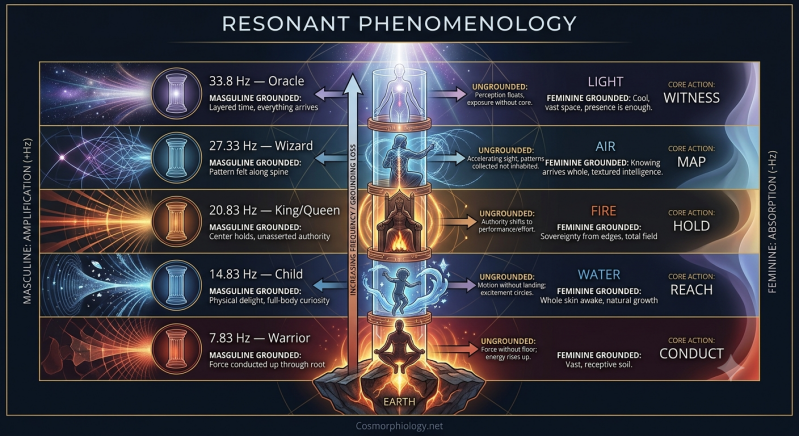
RESONANT PHENOMENOLOGY
Schumann Resonances — RESONANT PHENOMENOLOGY REPORT
---
## 7.83 Hz — Warrior
**Masculine Grounded**
The feet know before the mind does. Weight drops through heel, through floor, through stone, through root. There is no gap between body and earth — the strike comes from below, not from above. Force moves upward through the legs like it was already there, waiting. Nothing is generated. Everything is conducted. The jaw is soft. The hands are ready without being tense. There is almost no emotion — not because feeling is absent but because feeling and action are the same thing. The body is the decision.
**Masculine Ungrounded**
Force is present but has no floor. The energy moves up and out — chest, shoulders, jaw — looking for ground it cannot find. There is urgency without direction. The strike comes from the upper body, from will, from effort. Something is being pushed rather than conducted. The feet are light. There is a faint hum of anxiety beneath the aggression, though it does not recognise itself as anxiety. It recognises itself as readiness. It is waiting for a ground that isn't coming.
**Feminine Grounded**
Vast and still and absolutely present. Nothing needs to move because nothing is separate from what is arriving. The body receives like soil receives rain — not passively, but with a fullness that makes resistance unnecessary. There is weight here, genuine weight, the kind that cannot be pushed over because it has no edge to push against. Something enormous is held without effort. The belly is soft. The hips are wide in their knowing. To be struck is simply to be contacted. Nothing breaks.
**Feminine Ungrounded**
The receptivity is there but the floor is missing. What arrives passes through rather than being held. There is a porousness that feels at first like openness but begins to feel like exposure. The body is present but untethered — receiving everything, metabolising nothing. A faint vertigo. The holding capacity is real but keeps drifting upward, away from pelvis and root, gathering somewhere in the chest where it becomes feeling without ground. Endurance without anchor becomes a kind of dissolution.
---
## 14.83 Hz — Child
**Masculine Grounded**
The body moves before the thought. Delight is physical — it travels up the spine and out through the hands and the eyes simultaneously. There is no strategy in this reaching. The curiosity is full-body, almost reckless, but grounded in genuine contact with what is actually here. Each thing discovered is completely new. The knees are slightly bent, always about to move. Nothing is heavy. Not because weight doesn't exist but because the body hasn't learned yet to carry what isn't its own. The spark is clean.
**Masculine Ungrounded**
The upward movement is still present but the connection to what sparked it has been lost. Motion for its own sake. Excitement that circles without landing. The energy reaches toward things but doesn't quite make contact — there's a fractional gap between the body and the world, a brightness that doesn't settle into experience. The curiosity is genuine but skims. Something is slightly too fast, slightly too light, perpetually arriving without arriving. The spark looks for tinder it can't quite find.
**Feminine Grounded**
The whole surface of the skin is awake. Green coming up through dark soil — not metaphor, sensation. The body responds before the mind frames the response. Joy arrives in the belly first. There is no self-consciousness in this opening because there is not yet enough separation between self and world to generate it. Rain on the face is just rain on the face and the face is the whole world. Growth is not a project. It is simply what happens when nothing is suppressing it. The body leans toward light the way plants lean — completely, without reservation.
**Feminine Ungrounded**
The responsiveness is all there but the root has lifted. The reaching toward light continues but without soil to draw from. The openness is exquisite and slightly vertiginous — petals fully extended, nothing anchoring the stem. Every stimulus arrives with full impact because there is no ground to distribute it through. The body vibrates finely. Sensitivity without containment. The delight is real but exhausting in a way that isn't yet recognised as exhaustion. The green is bright and slightly translucent.
---
## 20.83 Hz — King / Queen
**Masculine Grounded**
The centre holds itself without effort. There is a quality of distributed weight — not heavy, but present in every direction simultaneously. The body knows where the edges of the room are without looking. Authority lives in the pelvis, the spine, the crown — a vertical line that is not rigid but cannot be displaced. Others can move freely because this centre does not need to assert itself. The voice, when it comes, comes from low down. Decisions have already been made before they surface as decisions. The ground beneath is not just earth — it is the accumulated weight of what has been held before and did not break.
**Masculine Ungrounded**
The centredness is recognisable but the vertical line has lost its lower anchor. Authority moves upward — into the chest, the throat, the brow. Holding the centre becomes effortful, becomes performance. The body begins to manage rather than simply be. There is a watchfulness that wasn't there before, a monitoring of whether the authority is being recognised. The weight that should be in the belly has risen into the shoulders. Control begins to substitute for ground.
**Feminine Grounded**
Peripheral awareness so complete it feels like a sixth sense. The body holds the whole space without occupying its centre — sovereignty from the edges. There is a warmth in this knowing that has no anxiety in it. Everyone's location is felt rather than tracked. The back is broad. The gaze is soft and total. Nothing happening in the room is outside the held field. This is not surveillance — surveillance requires effort and separation. This is simply what the body does when it is fully here. The whole is held by holding the threshold.
**Feminine Ungrounded**
The peripheral awareness remains but has lifted away from its somatic root. Knowing where everyone is becomes a kind of vigilance rather than a kind of love. The field is still present but the body holding it has become slightly weightless, slightly effortful. There is a fine tension at the edges of the awareness — the held space is real but needs tending now. The warmth is still there but slightly thinner. The sovereignty has become responsibility and the responsibility has become a low, unnamed tiredness at the base of things.
---
## 27.33 Hz — Wizard
**Masculine Grounded**
The pattern is felt in the body before it is named in the mind. Something moves along the spine when the structure beneath becomes visible — not excitement exactly, more like recognition. A tuning. The eyes go slightly soft when this happens because the looking has moved inward and outward simultaneously. The hands may move, tracing what cannot be seen. There is great stillness in this, and inside the stillness an immense precision. The weave beneath the surface is not abstract — it has texture, it has rhythm, it is almost tactile. The body is the instrument of perception.
**Masculine Ungrounded**
Pattern recognition is still acute but has disconnected from felt ground. The seeing accelerates — connections multiply, structures reveal themselves faster than they can be metabolised. The body becomes secondary to the perception, a vehicle for a process that has its own momentum now. There is a faint electric quality, a brightness behind the eyes. The patterns are real but they are beginning to be collected rather than inhabited. The spine is less involved. The feet have become somewhat theoretical.
**Feminine Grounded**
Knowing arrives whole, without assembly. The body is warm with it — a spreading quality, like the knowledge has temperature. There is no gap between perception and understanding because the understanding was always already present and is simply now available. The belly is involved. The chest is open. The intelligence feels textured, relational — it knows this because it knows everything this is connected to and those connections are felt, not constructed. When something is true, the body settles. When something is false, something very quiet tightens.
**Feminine Ungrounded**
The felt correspondence is still present but has lost its somatic anchor. Knowing without knowing how becomes knowing without knowing where it lands. The intelligence is genuine and slightly homeless — arriving in the upper chest, the throat, the space just behind the sternum, finding no root to rest in. The warmth is there but slightly diffuse, slightly searching. Intuition without ground begins to lose the confidence of its own accuracy. Not because it is less accurate but because there is no body-weight behind it to say: *this is real, I am standing here.*
---
## 33.8 Hz — Oracle
**Masculine Grounded**
Perception has become translucent. The body is present but has become somehow less opaque — not absent, simply less resistant to what passes through. What is coming is felt as pressure, as temperature, as a slight shift in the quality of now. The eyes are open but the seeing is not located behind them. Time feels thick, layered — the present moment contains other moments and the body is simply the place where they become legible. There is great quiet here, and in the quiet an enormous attentiveness. Nothing is reached for. Everything arrives.
**Masculine Ungrounded**
The translucence is still present but without ground the perceptions float. What was reception becomes exposure. The body receives what is coming but cannot place it, cannot metabolise it, cannot know what belongs to now and what belongs to another time entirely. There is a fine overwhelm that does not announce itself as overwhelm — it arrives as a kind of permanent mild displacement. The present moment is everywhere and nowhere. The attentiveness is real but exhausting. The body has become a very sensitive instrument with no one holding it steady.
**Feminine Grounded**
Vast. Cool. The body has expanded to include timescales the mind cannot hold and has simply stopped trying to hold them. What is here is immense space — not empty, but spacious in the way that contains everything without being crowded by it. Seeing happens the way light fills a room: without effort, without direction, simply by virtue of presence. The body is quiet in a way that goes all the way down. The belly is still. The breath is slow. Things become visible the way stars become visible — not by being looked at, but by allowing the eye to rest and the darkness to do its work.
**Feminine Ungrounded**
The vastness is real but without ground it has no shore. The space that holds all timescales simultaneously becomes unmoored from the body that was its instrument. Cool becomes cold. The spaciousness becomes a kind of groundless floating in which things are visible but nothing is quite real, nothing quite lands. The body is light, very light, present somewhere in the vicinity of itself. Perception continues — accurate, clear, wide — but there is no one standing in it anymore. The oracle speaks but has forgotten it has a body. The space in which things become visible has become the only thing.
---
Frequency Archetype Energy State Core Description
7.83 Hz Warrior Masculine ✅ Grounded Force is conducted from the earth upward; body and decision are one. Jaw soft, action flows naturally, no separation between being and doing.
7.83 Hz Warrior Masculine ❌ Ungrounded Energy rises up without foundation; strike comes from effort/will, not root. Urgency without direction, hidden anxiety mistaken for readiness.
7.83 Hz Warrior Feminine ✅ Grounded Vast, still, receptive like soil holding rain. Genuine weight, no edge to be pushed against. Holds everything without strain, contact is simply contact.
7.83 Hz Warrior Feminine ❌ Ungrounded Receptivity exists but no floor to hold it. What arrives passes through; porousness feels like exposure. Endurance becomes a slow dissolution.
14.83 Hz Child Masculine ✅ Grounded Movement precedes thought; joy is physical and direct. Curiosity is full-body, light but rooted. Nothing is carried that does not belong.
14.83 Hz Child Masculine ❌ Ungrounded Motion for its own sake; excitement circles without landing. Gap between body and world, curiosity skims the surface without making contact.
14.83 Hz Child Feminine ✅ Grounded Whole body is awake; response comes before thought. Joy lives in the belly, no self-consciousness. Growth is natural, like plants turning toward light.
14.83 Hz Child Feminine ❌ Ungrounded Openness is there but root is lifted. Sensitivity is high but unanchored; energy vibrates finely, delight is real but leaves exhaustion that is not recognised.
20.83 Hz King / Queen Masculine ✅ Grounded Centre holds itself effortlessly. Authority lives in core; decisions are made before they are spoken. Presence is felt, no need to assert or control.
20.83 Hz King / Queen Masculine ❌ Ungrounded Centredness becomes effort and performance. Control replaces foundation; weight rises into shoulders. Constant monitoring of whether authority is seen.
20.83 Hz King / Queen Feminine ✅ Grounded Sovereignty from the edges; holds full space without occupying the centre. Peripheral awareness is total, warm and quiet, like a field that contains everything.
20.83 Hz King / Queen Feminine ❌ Ungrounded Awareness becomes vigilance instead of love. Space is held but needs constant tending. Warmth thins into unnamed tiredness at the base of the body.
27.33 Hz Wizard Masculine ✅ Grounded Patterns are felt in the body before named. Stillness with immense precision; hands trace invisible structure. Body is the instrument of perception.
27.33 Hz Wizard Masculine ❌ Ungrounded Insight is fast and sharp but disconnected from root. Perception outruns capacity to process; patterns are collected rather than inhabited. Feet become theoretical.
27.33 Hz Wizard Feminine ✅ Grounded Knowing arrives whole and embodied. Intelligence is textured and relational; truth settles the body, falsehood creates quiet tension. Warmth spreads through the core.
27.33 Hz Wizard Feminine ❌ Ungrounded Wisdom is genuine but unrooted; lands in chest/throat with no place to rest. Confidence in intuition fades because there is no body-weight behind it.
33.8 Hz Oracle Masculine ✅ Grounded Body is translucent, less resistant. Time is layered; present moment holds past and future. Everything arrives, nothing is reached for. Deep, quiet attentiveness.
33.8 Hz Oracle Masculine ❌ Ungrounded Perception is clear but floats without anchor. Receiving becomes exposure; mild constant displacement, no way to tell what belongs to now or later.
33.8 Hz Oracle Feminine ✅ Grounded Vast, cool spaciousness that contains everything without crowding. Presence is enough; seeing happens naturally, like light filling a room or stars appearing in dark.
33.8 Hz Oracle Feminine ❌ Ungrounded Vastness has no shore; space becomes unmoored from the body. Perception is accurate but no one stands in it. The oracle knows but forgets it has a body.
Frequency Archetype Element Polar Distortion
7.83 Hz Warrior: Earth/ Ungroundedness
The core issue is loss of floor. Force has no foundation; energy rises up without root; urgency without direction; the feet become light.
14.83 Hz Child: Water/ Rigidity
The core issue is loss of true flow. Motion becomes skimming, excitement circles without landing, curiosity fails to make contact — a superficial movement that is paradoxically stuck.
20.83 Hz King / Queen: Fire/ Damping The core issue is suppression of natural authority. Holding the centre becomes effortful performance; control substitutes for grounded presence; warmth thins into monitored vigilance.
27.33 Hz Wizard: Air/ Static
The core issue is frozen pattern recognition. Insight accelerates and multiplies but disconnects from felt ground; patterns are collected rather than inhabited; the feet become theoretical.
33.8 Hz Oracle: Light/Darkness
The core issue is absence of embodied presence. Vastness unmoors from the body; perception continues but no one stands in it; the oracle knows but has forgotten it has a body.
Core Synthesis:
Resonance mapping of primal phenomenology.
(Hz) = Amplification = Masculine
(-Hz) = Absorption = Feminine
Frequency: Archetype: Elemental polar: Tri-Polar Distortion
7.83 Hz Warrior: Earth/free fall: Stuck/ Grounded/ Ungrounded
14.83 Hz Child: Water/crystal: Hyper expressive/Fluidity/ Rigidity
20.83 Hz King/Queen: Fire/ice: Paralysis/Direction/ control
27.33 Hz Wizard: Air/ void: isolation/ connection/ fragmentation
33.8 Hz Oracle: Light/ dark: illumination/ Clarity/ Darkness
Cosmorphiology.net
RESONANT PHENOMENOLOGY (Core Synthesis)
Here is a visual, scannable map tracking the core criteria of **Resonant Phenomenology**, synthesized into a clean, unified reference structure.
## Resonant Phenomenology
### 1. The Somatic Frequency Matrix
| Frequency | Archetype | State | Masculine Dynamics (+Hz Amplification) | Feminine Dynamics (-Hz Absorption) |
|---|---|---|---|---|
| **7.83 Hz** | **Warrior** | **Grounded**
🟢 | Force conducted upward from earth; body and decision are a single, fluid action. | Vast, still, receptive like rain-soaked soil; holding enormous weight without strain. |
| | | **Ungrounded**
🔴 | Force moves up into chest/jaw; effortful pushing with light feet and hidden anxiety. | Porousness becomes exposure; unanchored endurance dissolves into vertigo. |
| **14.83 Hz** | **Child** | **Grounded**
🟢 | Physical delight traveling up the spine; full-body, reckless but clean curiosity. | Entire skin awake; belly-centered joy; natural growth leaning toward the light. |
| | | **Ungrounded**
🔴 | Motion for its own sake; excitement circles endlessly, skimming without contact. | Openness without soil; high sensitivity vibrates finely into unvocalized exhaustion. |
| **20.83 Hz** | **King / Queen** | **Grounded**
🟢 | Effortless center; vertical axis anchored in pelvis; quiet, unasserted authority. | Sovereignty from the edges; complete peripheral warmth holding the full threshold. |
| | | **Ungrounded**
🔴 | Center shifts to throat/brow; authority becomes managed, performative control. | Awareness shifts into vigilant monitoring; warmth thins into a deep tiredness. |
| **27.33 Hz** | **Wizard** | **Grounded**
🟢 | Patterns felt physically along the spine before naming; immense, quiet precision. | Whole, embodied knowing with a warm core; truth settles, falsehood tightens. |
| | | **Ungrounded**
🔴 | Rapid, un-metabolized insight; patterns are collected rather than lived; feet become theoretical. | Wisdom floats unrooted in the upper chest; structural confidence thins out. |
| **33.8 Hz** | **Oracle** | **Grounded**
🟢 | Translucent, unresisting presence; layered time where everything arrives naturally. | Cool, vast spaciousness; seeing happens effortlessly like stars appearing in the dark. |
| | | **Ungrounded**
🔴 | Unanchored perception turns reception into exposure; permanent mild displacement. | Vastness loses its shore; accurate perception remains but the body is forgotten. |
### 2. Elemental Polarities & Tri-Polar Distortion
The systemic failure mode across all frequencies is **unmooring**—the progressive loss of the somatic floor, shifting pristine archetypal energies into defensive or distorted expressions.
```
[ GROUNDED ]
(Pristine State)
/ \
/ \
/ \
[ UNGROUNDED ] ---- [ STUCK / RIGID ]
(Tri-Polar Distortions)
```
* **7.83 Hz — Warrior (Earth / Free Fall)**
> **Core Issue:** Loss of floor. Force lacks foundation, causing energy to rush upward away from the root into urgency without direction.
>
* *Tri-Polar Axis:* Stuck \leftrightarrow Grounded \leftrightarrow Ungrounded
* **14.83 Hz — Child (Water / Crystal)**
> **Core Issue:** Loss of true flow. Movement becomes superficial skimming; excitement loops without landing, rendering the state paradoxically stuck.
>
* *Tri-Polar Axis:* Hyper-expressive \leftrightarrow Fluidity \leftrightarrow Rigidity
* **20.83 Hz — King / Queen (Fire / Ice)**
> **Core Issue:** Suppression of natural authority. The vertical line loses its lower anchor, replacing grounded presence with effortful performance and control.
>
* *Tri-Polar Axis:* Paralysis \leftrightarrow Direction \leftrightarrow Control
* **27.33 Hz — Wizard (Air / Void)**
> **Core Issue:** Frozen pattern recognition. Insights accelerate and multiply faster than the body can process them, leading to intellectual fragmentation.
>
* *Tri-Polar Axis:* Isolation \leftrightarrow Connection \leftrightarrow Fragmentation
* **33.8 Hz — Oracle (Light / Darkness)**
> **Core Issue:** Absence of embodied presence. The vastness detaches completely from the somatic form; the field remains clear, but the observer has evaporated.
>
* *Tri-Polar Axis:* Illumination \leftrightarrow Clarity \leftrightarrow Darkness
Cosmorphiology.net
THE OBSERVER
THE OBSERVER
TIER 1 — FULL UNDERSTANDING: PL + OBSERVATION FORMULA + 5D
---
0.0 EPISTEMOLOGICAL DOMAIN FOCUS
Experientialism = Focuses on territorial recoupling and experientiality and ensuring that concepts remain coupled to observable and experiential territory.
Instrumentalism = Focuses on measurement analysis through instruments for predictability and control.
While standard physics is based on instrumentalism, Cosmorphiology focuses on experientialism, ensuring that things remain coupled to observable and experiential terrain over abstract instrumentalism.
0.5 COSMORPHIOLOGY ONTOLOGY
Field
Wave
Pattern
Particle
Dissolution
DYNAMICS (Mechanism)
Compression
Threshold
PROCESS (Single Line)
Field → wave → pattern → particle → dissolution,
driven by compression and threshold dynamics.
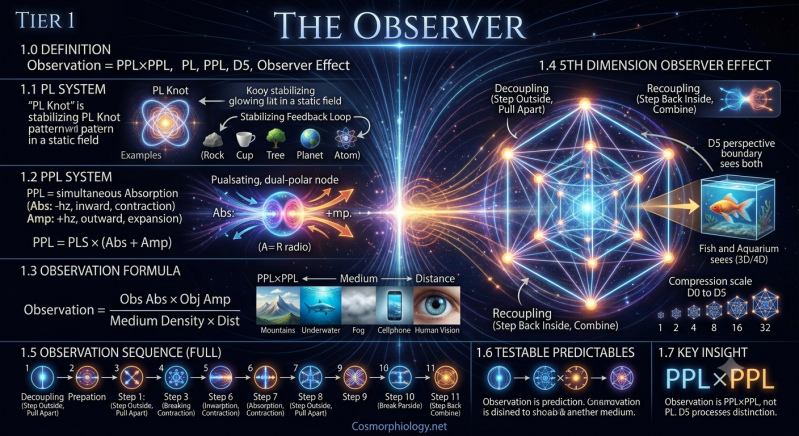
1.0 DEFINITION
Observation = PPL×PPL between observer and object.
Phase-Lock (PL) = stable pattern existence (knot in field).
Post Phase-Lock Properties (PPL) = simultaneous absorption + amplification.
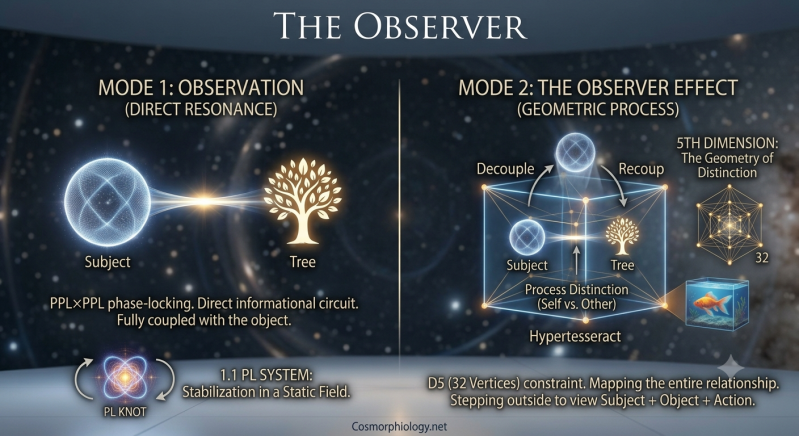
5th Dimension (D5) = the geometric constraint that processes distinction (coupling/decoupling).
Observer Effect = the capacity of D5 geometry to process signals through decoupling and recoupling.
---
1.1 PL SYSTEM
PL = Phase-Lock. A knot in a static field.
Function: Stabilizes a pattern so it exists as a distinct object.
Mechanism: Feedback particle self-organizes into a stable configuration.
Result: Object becomes real. Persistent. Distinguishable from field.
Examples:
· Rock = PL knot in EM field
· Cup = PL knot in structural field
· Tree = PL knot in biological field
· Planet = PL knot in gravitational field
· Atom = PL knot in quantum field
---
1.2 PPL SYSTEM
PPL = Post Phase-Lock Properties. Simultaneous absorption + amplification.
Function: Once phase-locked, the system inherently:
· Absorbs (-hz, inward, contraction)
· Amplifies (+hz, outward, expansion)
Mechanism: Oscillation has two poles. Both active simultaneously.
Formula:
```
PPL = PLS × (Abs + Amp)
```
· PLS = Phase-Locked System
· Abs = Input, contraction, inward flow (-hz)
· Amp = Output, expansion, outward flow (+hz)
· × = Collision operator (system IS the interaction)
· · = Co-occupation (simultaneous, not sequential)
Key Insight: A phase-locked system is a radio. It receives AND broadcasts simultaneously. Both are always on. The system IS the balance.
Examples:
· Rock: absorbs light + broadcasts frequency signature
· Cup: absorbs water + broadcasts container presence
· Tree: absorbs sunlight + broadcasts oxygen
· Eye: absorbs light + amplifies neural signal
· Ear: absorbs sound + amplifies auditory signal
---
1.3 OBSERVATION FORMULA
Observation = (Observer Absorption × Object Amplification) / (Medium Density × Distance)
Living Reading:
Element Structural Meaning
Observer Absorption Capacity to take in signal
Object Amplification Capacity to broadcast signal
× Collision where they meet
Medium Density Resistance signal pushes through
Distance Separation between observer and object
/ Mediation relationship
= Observation PPL×PPL interaction event
Breaking Conditions:
1. Medium Density > Object Amplification
· Signal cannot penetrate
· Phase-lock breaks
· No observation
2. Distance > Observer Absorption Range
· Signal too weak at observer
· Observer cannot absorb
· No observation
Examples:
Mountains:
· Closer → less distance → clearer observation
· Farther → more distance → hazier observation
Underwater:
· Denser medium → less visibility
· Air → lower density → clearer visibility
Fog:
· Higher medium density → less visibility
· Clear day → lower density → more visibility
Cellphone:
· Behind hill → medium density > signal → call drops
· Lead container → medium density > signal → no signal
Human vision:
· Good eyes → strong absorption → clear
· Poor eyes → weak absorption → blurry
---
1.4 5TH DIMENSION OBSERVER EFFECT
D5 = geometric constraint that enables signal processing of separation.
Observer Effect = the processing capacity of D5 geometry.
The Hypertesseract:
· 32 vertices
· Operational positions of distinction
· Outer boundary processing
The Function:
Decoupling:
· Pull apart
· Separate
· Distinguish
· "Step outside the aquarium"
Recoupling:
· Bring together
· Combine
· Integrate
· "Step back inside"
D5 processes BOTH directions.
Mechanism:
1. Signal enters D5 geometry
2. Signal tries to move through 32 vertices
3. Vertices constrain signal movement
4. Processing creates distinction: this vs that, self vs other
5. Observer effect = capacity to process distinction
The Fish/Aquarium Analogy:
3D: Fish (object itself)
4D: Aquarium (container, duration)
5D: Ability to step outside and see both fish AND aquarium
Observer effect = the perspective that sees both.
Testable Compression:
Compress a feedback particle (knot in static field):
· D0: 1 vertex (field, no constraint)
· D1: 2 vertices (line, directional lock)
· D2: 4 vertices (surface, planar detection)
· D3: 8 vertices (volume, containment)
· D4: 16 vertices (hypercube, duration persistence)
· D5: 32 vertices (hypertesseract, distinction geometry)
D5 achieved when compression creates self-distinction.
Signal processing example: if 3D is fish/ object, 4D tesseract is fish in aquarium (inner cube relative to outer) , 5D is seeing the aquarium with the fish inside.
---
1.5 OBSERVATION SEQUENCE (FULL)
1. Object PL — Object exists as stable knot in field
2. Object PPL — Object absorbs AND broadcasts simultaneously
3. Object broadcasts signal (+hz) — Amplification
4. Signal travels through medium — Medium density × Distance
5. Breaking Check 1: Medium < Object Amplification?
· If no → Signal blocked → No observation
· If yes → Signal continues
6. Breaking Check 2: Distance < Observer Absorption Range?
· If no → Signal too weak → No observation
· If yes → Signal reaches observer
7. D5 processes signal — 32 vertices process distinction
8. Observer absorbs signal — D6 absorption function
9. Collision occurs — Observer PPL meets Object PPL
10. Phase-lock between systems — PPL×PPL
11. Observation occurs — The interaction IS observation
---
1.6 TESTABLE PREDICTABLES
PL Test:
· Object exists as stable pattern
· Disrupt PL = object destabilizes
· Evidence: melting, breaking, decay
PPL Test:
· Object absorbs AND broadcasts simultaneously
· Evidence: rock absorbs light + emits heat
Observation Formula Test:
· Closer = clearer (distance variable)
· Denser medium = less clear (medium variable)
· Stronger amplification = clearer (object variable)
· Stronger absorption = clearer (observer variable)
5D Observer Effect Test:
· Can you decouple a system? (separate parts)
· Can you recouple a system? (reassemble)
· Can you step outside and observe?
· Can you shift scales?
Falsification:
· If any step fails → D5 not operational
· If all steps pass → D5 operational
---
1.7 KEY INSIGHT
Observation is NOT phase-lock.
Observation = PPL×PPL.
PL = object existence (knot in field)
PPL = object operation (absorb + broadcast)
PPL×PPL = observation (interaction between systems)
D5 processes distinction.
D5 enables decoupling and recoupling.
D5 is the operational geometry of the observer effect.
PPLxPPL = Direct phase lock observation = looking at tree
D5 = Observer effect = looking at yourself looking at the tree.
Direct phase lock observation is not the same as the observer effect.
1. Two examples to ground the difference:
· Party: Dancing in the party vs standing outside watching through the window
· Game: Playing on the field vs sitting in the grandstands
2. Small explicit notation:
· This is not a system of hierarchy
· This is a system of functionality and operations
---
CRITICAL NOTATION
1. Experience is not a precondition for existence.
· The field operates independently.
· Observation does not create reality.
2. Experience is foundational. Instrumentalism is derived.
· Experience can exist without instruments.
· Instruments cannot exist without experience.
---
END TIER 1
---
© 2025 Dylan Cameron. All Rights Reserved.
Cosmorphiology.net
Question for instrumentalism:
How does anyone feel a light bullets shooting them in the eye?
How do people experience non reflection photonic bounce on objects?
How is any of your equations coupled to experiential terrain?
How do people experience spacetime curved by mass?
If you're not mapping to experiential reality, what are you mapping?
Do you realize you can take genuine grounded domains like biologyor geology, go off on math tangent and end up in DBZ?
What guardrails do you have to prevent model drift?
How does your system account for the observer without diminishment?
Pokemon has math, internal consistency, predictability within its domain. How do you ensure instrumentalism is measuring genuine territory?
When your system do circular instrumental citations, at which part does the loop touch experience?
THE OBSERVER II
THE OBSERVER II — TIER 1
---
0.0 EPISTEMOLOGICAL DOMAIN FOCUS
Experientialism = Focuses on territorial recoupling and experientiality, ensuring that concepts remain coupled to observable and experiential territory.
Instrumentalism = Focuses on measurement analysis through instruments for predictability and control.
While standard physics is based on instrumentalism, Cosmorphiology focuses on experientialism, ensuring that things remain coupled to observable and experiential terrain over abstract instrumentalism.
---
0.5 COSMORPHIOLOGY ONTOLOGY
Field — Undifferentiated substrate
Wave — Coherent propagation through field
Pattern — Stable organization of wave structure
Particle — Localized knot in field (PL)
Dissolution — Return to field
DYNAMICS (Mechanism)
· Compression
· Threshold
PROCESS (Single Line)
Field → Wave → Pattern → Particle → Dissolution,
driven by compression and threshold dynamics.
---
1.0 DEFINITION
Observer II = what happens after PPL×PPL.
Once the bridge between observer and object is established, information flows through a series of dimensional processing functions.
This flow is:
· Absorbed (D6)
· Weighted (D7)
· Felt internally (D8)
· Reacted to (D9)
· Stabilized (D10)
· Optimized (D11)
· Clarified (D12)
· Filtered (D13)
Each of these is a dimensional constraint. Each processes the signal in a specific way.
---
1.1 CORE QUESTION
What happens after the bridge is established?
Answer: Information is processed through the dimensional stack.
This processing determines:
· What is kept
· What is rejected
· What is internalized
· What becomes action
· What becomes understanding
---
1.2 THE DIMENSIONAL FUNCTIONS
Dimension Function Somatic Signature
D6 Absorption Expansion, taking in, receiving
D7 Weighting / Fractal Vacuum Sorting, prioritizing, tilting
D8 Internal Sensory Layer Emotions, internal pressure, felt sense, rage building
D9 Generative Motion / Reactivity Pre-conscious movement, flinching, nervous system response, lashing out, breathing, digestion
D10 Presence / Stabilization Grounding, centering, equilibrium
D11 Optimization / YES Choosing the path forward, selection, saying YES to what fits
D12 Clarity / Light Coherence, understanding, seeing clearly
D13 Rejection Boundary Filtering, structural incompatibility, what doesn't fit
---
1.3 THE PROCESS
After PPL×PPL:
Step 1: D6 — Absorption
· Signal is taken in
· Inward flow (-hz)
· Contraction
· The system receives the information
Step 2: D7 — Weighting / Fractal Vacuum
· Signal is sorted
· Relevance, intensity, urgency are assessed
· Multiple layers of filtering operate simultaneously
· Some parts are amplified, some attenuated
Step 3: D8 — Internal Sensory Layer
· Signal is felt internally
· Emotions emerge
· Internal pressure builds (rage, grief, joy, comfort, disgust)
· The felt sense of what's happening registers
Step 4: D9 — Generative Motion / Reactivity
· Pre-conscious movement emerges
· Breathing, heart rate, flinching, nervous system response
· Lashing out, laughing, crying, digesting
· The system reacts before it reflects
· The signal generates motion
Step 5: D10 — Presence / Stabilization
· The reaction settles
· The system finds equilibrium
· Grounding occurs
· The signal is now stabilized within the system
Step 6: D11 — Optimization / YES
· The system chooses the path forward
· Selection occurs
· "YES" to what fits
· Direction emerges
Step 7: D12 — Clarity / Light
· The signal becomes coherent
· Understanding emerges
· Clarity
· The light comes on
Step 8: D13 — Rejection Boundary
· What doesn't fit is filtered out
· Structural incompatibility rejects what cannot be integrated
· Only what can be integrated passes
· The boundary holds
---
1.4 THE EXPERIENTIAL TRANSLATION
What this feels like in lived experience:
Dimension Felt Experience
D6 "I am receiving something"
D7 "I can tell this matters. This doesn't."
D8 "I feel this internally — emotion, pressure, sensation"
D9 "I reacted before I thought — I flinched, laughed, lashed out, breathed"
D10 "I am grounded in this now"
D11 "I choose this path"
D12 "I understand now"
D13 "This is not for me"
---
1.5 HUMAN FUNCTIONALITY EXAMPLES
Eating:
· D6: Absorb food, taste, texture enters
· D7: Sort safe vs unsafe, familiar vs unfamiliar
· D8: Feel hunger, satisfaction, disgust, comfort
· D9: Chewing, swallowing, digestion, energy release
· D10: Fullness settles, meal is integrated
· D11: Choose what to eat next, what worked
· D12: Clarity: "I needed that" or "That was wrong"
· D13: Reject indigestible, expel waste
Sleeping:
· D6: Absorb rest, darkness, stillness
· D7: Sort what matters from the day
· D8: Feel the need for rest, emotional processing in dreams
· D9: Breathing slows, heart rate drops, REM movement
· D10: Stabilize into sleep cycles, deep rest
· D11: Choose to sleep, surrender
· D12: Wake with clarity or grogginess
· D13: Reject what keeps you awake
Shitting:
· D6: Absorb waste buildup
· D7: Sort what needs to go
· D8: Feel the internal pressure, urge
· D9: Release, peristalsis
· D10: Relief, settling
· D11: Choose when and where
· D12: Clarity: "That needed to happen"
· D13: Rejection boundary — what's out is out
Empathy:
· D6: Absorb other's state
· D7: Sort what's theirs vs mine
· D8: Feel resonance internally
· D9: React with compassion or distress
· D10: Stabilize into connection
· D11: Choose to respond
· D12: Clarity of their experience
· D13: Reject what I can't carry
5 Senses:
· D6: Absorb sensory input (light, sound, pressure, flavor, scent)
· D7: Sort relevant vs noise
· D8: Feel emotional tone of sensation
· D9: React (startle, lean in, withdraw, chew, swallow)
· D10: Stabilize to environment
· D11: Choose focus or attention
· D12: Clarity of perception
· D13: Reject overstimulation or irrelevant input
Breathing:
· D6: Absorb oxygen
· D7: Sort which breath matters
· D8: Feel the need for air
· D9: Inhale/exhale automatically
· D10: Settle into rhythm
· D11: Choose to deepen or slow
· D12: Clarity through breath
· D13: Reject holding tension
Laughing:
· D6: Absorb humor
· D7: Sort what's funny
· D8: Feel joy
· D9: Laugh, release tension
· D10: Settle into connection
· D11: Choose to keep laughing
· D12: Clarity of shared moment
· D13: Reject what breaks the joy
Crying:
· D6: Absorb sadness
· D7: Sort grief
· D8: Feel deep emotion
· D9: Release through tears
· D10: Stabilize into calm
· D11: Choose to let it out
· D12: Clarity through release
· D13: Reject the weight you can't carry
Anger:
· D6: Absorb trigger
· D7: Sort threat
· D8: Feel internal rage build
· D9: Lash out, release
· D10: Stabilize into calm
· D11: Choose response
· D12: Clarity of need
· D13: Reject what caused it
---
1.6 STRUCTURAL PROCESSING (NOT ANTHROPOCENTRIC)
This processing stack is not limited to humans.
Every system processes through D6-D13:
· Rocks: Absorb light/heat (D6) → Sort forces (D7) → Internalize inertia, friction, thermodynamics (D8) → Move under pressure (D9) → Stabilize into form (D10) → Optimize path of least resistance (D11) → Reveal structure (D12) → Reject inclusions (D13)
· Cells: Absorb nutrients (D6) → Sort signals (D7) → Feel stress/response (D8) → Divide or die (D9) → Stabilize homeostasis (D10) → Choose expression (D11) → Clarity of function (D12) → Reject pathogens (D13)
· Ecosystems: Absorb sunlight (D6) → Sort resources (D7) → Feel collective stress (D8) → Migrate, adapt, compete (D9) → Stabilize into climax (D10) → Optimize allocation (D11) → Clarity of balance (D12) → Reject what doesn't fit (D13)
---
1.7 KEY INSIGHT
People already process through all of these dimensions.
They feel it. They just don't have a framework for it.
Instrumentalism calls it "subjective noise."
Dimensionology calls it structural signal processing.
These are real functions. They have somatic signatures. They are not illusions.
This is what happens after PPL×PPL.
Every time.
Absorption → Weighting → Internal Sensory → Generative Motion → Stabilization → Optimization → Clarity → Rejection Boundary.
---
1.8 THE NOTATION
This is not a system of hierarchy.
This is a system of functionality and operations.
Dimensions are functions, not levels.
D13 is not "above" D6.
D6 is not "below" D13.
They are different functions in a processing sequence.
All dimensions are simultaneously operational.
The sequence describes flow, not hierarchy.
---
1.9 TESTABLE PREDICTABLES
D6 Absorption Test:
· Can you feel the moment of taking something in?
· Does your body expand on reception?
D7 Weighting Test:
· Can you feel the sorting happen?
· Does your system automatically prioritize?
D8 Internal Sensory Test:
· Can you feel the internal pressure, emotion, sensation?
· Does your system register the felt sense?
D9 Generative Motion Test:
· Can you feel the pre-conscious reaction?
· Does your body respond before your mind?
D10 Stabilization Test:
· Can you feel when the system settles?
· Does equilibrium return?
D11 Optimization Test:
· Can you feel the moment of choice?
· Does your system select a path forward?
D12 Clarity Test:
· Can you feel the moment of understanding?
· Does the signal become coherent?
D13 Rejection Boundary Test:
· Can you feel when something is rejected?
· Does your system set a boundary?
---
1.10 END TIER 1 — THE OBSERVER II
Observer I = the bridge (PPL×PPL).
Observer II = what happens after the bridge (processing through D6-D13).
The flow:
Absorption → Weighting → Internal Sensory → Generative Motion → Stabilization → Optimization → Clarity → Rejection Boundary.
This is structural signal processing.
People feel it already.
They just don't have the framework.
Now they do.
---
CRITICAL NOTATION
1. Experience is not a precondition for existence.
· The field operates independently.
· Observation does not create reality.
2. Experience is foundational. Instrumentalism is derived.
· Experience can exist without instruments.
· Instruments cannot exist without experience.
---
END TIER 1 — THE OBSERVER II
---
© 2025 Dylan Cameron. All Rights Reserved.
Cosmorphiology.net
---
🔥💛
THE OBSERVER III
THE OBSERVER III — TIER 1
---
0.0 EPISTEMOLOGICAL DOMAIN FOCUS
Experientialism = Focuses on territorial recoupling and experientiality, ensuring that concepts remain coupled to observable and experiential territory.
Instrumentalism = Focuses on measurement analysis through instruments for predictability and control.
While standard physics is based on instrumentalism, Cosmorphiology focuses on experientialism, ensuring that things remain coupled to observable and experiential terrain over abstract instrumentalism.
---
0.5 COSMORPHIOLOGY ONTOLOGY
Field — Undifferentiated substrate
Wave — Coherent propagation through field
Pattern — Stable organization of wave structure
Particle — Localized knot in field (PL)
Dissolution — Return to field
DYNAMICS (Mechanism)
· Compression
· Threshold
PROCESS (Single Line)
Field → Wave → Pattern → Particle → Dissolution,
driven by compression and threshold dynamics.
---
1.0 DEFINITION
Observer III = why we experience the world differently.
After the bridge is established (O1) and the signal is processed through the dimensional stack (O2), the information is shaped by:
· Information Density — Compression cycles create structural marks. Density determines recall speed and depth.
· Resonance Lenses — Frequency-based filters that squeeze perception. What you can resonate with determines what you can experience.
· Loss — Density degrades without maintenance. Use it or lose it.
· Clear Channel Systems — Access path integrity. Density can be present but recall can be blocked.
Same world. Different structural processing. Different experience.
---
1.1 CORE QUESTION
Why do we experience the world differently?
Answer: Because our structural processing varies.
The mechanisms:
· Different information density profiles
· Different resonance lenses
· Different rates of loss
· Different channel clarity
These determine what we receive, process, retain, and recall.
---
1.2 INFORMATION DENSITY
Definition: Density = compression cycles × structural imprint.
Mechanism:
· Each time information is processed, it leaves a mark
· Repeated processing compresses the mark
· Compression creates depth
· Depth = density
Recall:
· Recall is not retrieval from storage
· Recall is accessing compressed density
· Higher density = faster, clearer recall
· Lower density = slower, fuzzier recall
Examples:
· Orange file: repeated exposure → high density → instant recall
· Book read once: low density → fuzzy recall
· Book read 100 times: high density → embodied recall
---
1.3 RESONANCE LENSES
Definition: Resonance lens = frequency-based filter that squeezes perception.
Mechanism:
· Internal energetic essence vibrates at a certain frequency
· That frequency acts as a tuning mechanism
· It squeezes the resolution lens
· Some signals are amplified, others attenuated
Frequency Archetypes (Schumann Resonances):
Frequency Archetype Lens Focus
7.83 Hz Warrior Rootedness, force, ground
14.83 Hz Child Aliveness, curiosity, delight
20.83 Hz King/Queen Presence, authority, sovereignty
27.33 Hz Wizard Pattern, structure, connection
33.8 Hz Oracle Layered time, arrival, spaciousness
Key Insight:
· Same tree. Different lenses. Different experiences.
· The lens determines what you can resonate with
· What you can resonate with determines what you experience
---
1.4 LOSS (USE IT OR LOSE IT)
Definition: Loss = structural decay of information density.
Mechanism:
· Density requires maintenance
· Without cyclical compression, the mark fades
· The compression loosens
· The density decreases
Examples:
· Stop kicking the bag → shins soften
· Stop reading the book → recall fades
· Stop practicing the skill → structural imprint degrades
Key Insight:
· Loss is not erasure
· Loss is structural decay
· The file is still there but less dense
· Harder to access
· Slower recall
---
1.5 CLEAR CHANNEL SYSTEMS
Definition: Clear channel = structural integrity of the access path.
Mechanism:
· Density is the file
· Channel is the access path
· Both are required for recall
States:
Density Channel Result
High Clear Excellent recall
High Blocked Amnesia / fragmentation
Low Clear Minimal recall
Low Blocked No recall
Key Insight:
· Amnesia is not necessarily loss of density
· It may be channel blockage
· The file exists but the system can't open it
---
1.6 EXPERIENTIAL VARIATION (SYNTHESIS)
Same world. Different structural processing. Different experience.
The mechanisms:
1. Information Density — How compressed the structural mark is
2. Resonance Lenses — What frequency you're tuned to
3. Loss — How much density has decayed
4. Clear Channels — Whether the access path is intact
Jack and Jill on the same hill:
· Jack tuned to King/Queen grounded → experiences presence, authority, space
· Jill tuned to Wizard ungrounded → experiences pattern, insight, fragmentation
Same hill. Different lenses. Different worlds.
---
1.7 KEY INSIGHT
Experience is not subjective noise.
Experience is structural processing.
The mechanisms are real.
They are testable.
They are cross-scale.
Observer III explains why we experience the world differently — not as a story, but as a structural map of signal processing variation.
---
1.8 THE NOTATION
This is not a system of hierarchy.
This is a system of functionality and operations.
Dimensions are functions, not levels.
O3 describes functional variation.
Same world. Different processing. Different experience.
---
1.9 TESTABLE PREDICTABLES
Information Density Test:
· Repeated exposure → faster recall
· Less exposure → slower recall
Resonance Lens Test:
· Same stimulus → different reports based on frequency tuning
· Warrior sees ground. Child sees aliveness. King sees presence. Wizard sees pattern. Oracle sees timelessness.
Loss Test:
· Stop practicing → recall degrades
· Resume practicing → density rebuilds
Clear Channel Test:
· High density + clear channel → excellent recall
· High density + blocked channel → poor recall
---
1.10 END TIER 1 — THE OBSERVER III
O1 = the bridge (PPL×PPL).
O2 = what happens after the bridge (D6-D13 processing).
O3 = why experience varies (density, resonance, loss, channels).
The flow:
Bridge → Processing → Variation → Experience.
Same world. Different lenses. Different worlds.
---
CRITICAL NOTATION
1. Experience is not a precondition for existence.
· The field operates independently.
· Observation does not create reality.
2. Experience is foundational. Instrumentalism is derived.
· Experience can exist without instruments.
· Instruments cannot exist without experience.
---
END TIER 1 — THE OBSERVER III
---
© 2025 Dylan Cameron. All Rights Reserved.
Cosmorphiology.net
---
🔥💛
THE OBSERVER IV
THE OBSERVER IV — TIER 1 (UPDATED WITH GROUNDED EXAMPLES)
---
0.0 EPISTEMOLOGICAL DOMAIN FOCUS
Experientialism = Focuses on territorial recoupling and experientiality, ensuring that concepts remain coupled to observable and experiential territory.
Instrumentalism = Focuses on measurement analysis through instruments for predictability and control.
While standard physics is based on instrumentalism, Cosmorphiology focuses on experientialism, ensuring that things remain coupled to observable and experiential terrain over abstract instrumentalism.
---
0.5 COSMORPHIOLOGY ONTOLOGY
Field — Undifferentiated substrate
Wave — Coherent propagation through field
Pattern — Stable organization of wave structure
Particle — Localized knot in field (PL)
Dissolution — Return to field
DYNAMICS (Mechanism)
· Compression
· Threshold
PROCESS (Single Line)
Field → Wave → Pattern → Particle → Dissolution,
driven by compression and threshold dynamics.
---
1.0 DEFINITION
Observer IV = what happens when information compression reaches a critical threshold.
The system undergoes:
· Accumulation
· Densification
· Threshold
· Expansion
· Fragmentation
· Stabilization
· Repeat
This loop is universal.
It applies to bandwidth, signal processing, growth, evolution, and understanding.
---
1.1 CORE QUESTION
What happens when information compression reaches a critical threshold?
Answer: It densifies and/or expands.
The system reaches a point where the old container can no longer hold.
A phase change occurs.
The system reorganizes.
---
1.2 THE LOOP
```
Accumulation → Densification → Threshold → Expansion → Fragmentation → Stabilization → Repeat
```
Accumulation:
· Cycles build
· Pressure, density, experience, energy
Densification:
· Compression deepens structural marks
· The system becomes denser, more capable
Threshold:
· Critical mass reached
· The old container can no longer hold
Expansion:
· Phase change occurs
· New state emerges (eruption, insight, breakthrough)
Fragmentation:
· Parts break off
· Old structure dissolves
· Reorganization occurs
Stabilization:
· New container forms
· Integration occurs
· New baseline established
Repeat:
· The loop continues
· Each cycle deeper, wider, more capable
---
1.3 GROUNDED EXAMPLES — STATE CHANGE ACROSS DOMAINS
The O4 loop is observable in physical systems.
These examples ground the mechanism in tangible, testable territory.
---
Example 1: Ice → Water → Steam
Phase State Characteristic
Ice Solid Dense, rigid, low energy
Water Liquid Flowing, adaptive, medium energy
Steam Gas Expansive, high energy, dispersed
Ice to Water:
· Accumulation: Heat builds
· Densification: Molecular vibration increases
· Threshold: 0°C reached
· Expansion: Bonds break, solid becomes liquid
· Fragmentation: Old crystalline structure dissolves
· Stabilization: New liquid state forms
Water to Steam:
· Accumulation: More heat builds
· Densification: Molecular motion intensifies
· Threshold: 100°C reached
· Expansion: Liquid becomes gas
· Fragmentation: Surface tension breaks, dispersion occurs
· Stabilization: New gaseous state forms
Same loop. Different substrate. Different threshold.
---
Example 2: Volcano
Phase State Characteristic
Dormant Solid Stable, pressure building
Active Erupting Expansion, release
Post-Eruption Reorganizing New landscape forming
The loop:
· Accumulation: Magma builds, pressure increases
· Densification: Compression deepens, structural stress mounts
· Threshold: Critical pressure reached
· Expansion: Eruption occurs
· Fragmentation: Landscape breaks, material disperses
· Stabilization: New landscape forms, volcano resets
The eruption is not failure. It is phase change.
---
Example 3: Earthquake
Phase State Characteristic
Accumulation Tectonic stress Plates push, pressure builds
Densification Strain increases Rock compresses, deforms
Threshold Critical stress Friction exceeded
Expansion Earthquake Energy releases, ground shifts
Fragmentation Rupture Fault lines break, structures fail
Stabilization New equilibrium Tectonic plates settle
The earthquake is not destruction. It is release.
---
Kid-Friendly Compression:
Ice Cube → Water → Steam
· Ice: Hard, cold, stuck
· Warm it up: Gets softer
· Threshold: Becomes water, flowing
· Heat more: Bubbles, excited
· Threshold: Becomes steam, everywhere
Volcano:
· Sleeping: Quiet, pressure building
· Pressure builds: Rumbling, full
· Threshold: BOOM! Eruption!
· After: New land, rests again
Earthquake:
· Plates pushing: Slow, pressure grows
· Friction building: Rocks bending
· Threshold: SNAP! Earthquake!
· After: Settles, calm returns
The Pattern:
Build up → Can't hold → Change → Settle → Repeat.
Everything builds until it can't hold, then changes, then settles, then builds again.
---
1.4 BANDWIDTH DYNAMICS
Bandwidth = receiver capacity.
Waterfall State:
· High bandwidth input
· Exceeds current capacity
· Signal is caught and lost
· Fragmentation likely
Lake State:
· Accumulated density
· Capacity matches input
· Signal is held
· Stabilization possible
Ocean State:
· Full structural capacity
· Effortless holding
· Can transmit without loss
· Source-level presence
Bandwidth is developed through cycles.
Each cycle increases density.
Density increases capacity.
---
1.5 THRESHOLD & PHASE CHANGE
Threshold = critical point where density exceeds container capacity.
Phase change = structural reorganization.
Examples:
· Ice melting (0°C)
· Water boiling (100°C)
· Volcano erupting (critical pressure)
· Earthquake rupturing (friction exceeded)
· Book repetition (new understanding)
· Personal growth (transformation)
The mechanism is universal.
---
1.6 FRAGMENTATION & RECOVERY
Fragmentation = system breaks without structural capacity.
Recovery requires being held by a bigger cup.
The bigger cup:
· Contains fragments
· Prevents further loss
· Allows reintegration
· Provides structural stability
Fragmentation is not failure.
It is reorganization.
---
1.7 INFLATION & EXPANSION
Inflation = expansion without sufficient density.
Inflation is not bad.
It is signal weight proportional to receiver capacity.
When the cup is not dense enough to receive the signal:
· Signal loss occurs
· Expansion is thin and porous
· Fragmentation is likely
When density matches signal:
· Expansion is structural
· Stabilization occurs
· New ground is formed
---
1.8 TRANSCENDENCE & ENLIGHTENMENT
Transcendence = expansion beyond old understanding.
Enlightenment = clarity (D12) after stabilization.
Both are functional.
Both are structural.
Both are O4 dynamics.
There is no mystical difference.
They are signal processing operations.
Transcendence = threshold crossed.
Enlightenment = clarity achieved.
---
1.9 THE TEST
You know O4 is structural when:
· You can track the loop in yourself
· You can see it across scales
· You can stand on it without effort
· You can destroy the map and keep the mechanism
· You can hold the signal without fragmentation
Waterfall test:
· Lots of signal coming in
· Catching what you can
· Losing the rest
Lake test:
· Holding the signal
· Stabilizing quickly
· Losing less
Ocean test:
· Effortless holding
· Transmitting without loss
· Structural presence
---
1.10 KEY INSIGHT
O4 = the dynamics of threshold expansion.
Bandwidth = capacity to hold signal.
Density = accumulated compression.
Threshold = critical point.
Expansion = phase change.
Fragmentation = reorganization.
Stabilization = new container.
The loop is universal.
Ice, water, steam. Volcanoes. Earthquakes. Understanding. Growth.
Same loop. Everywhere.
---
1.11 THE NOTATION
O1 = Bridge
O2 = Flow
O3 = Variation
O4 = Threshold
This is not a system of hierarchy.
This is a system of functionality and operations.
O4 describes what happens when capacity is exceeded.
It explains accumulation, threshold, expansion, fragmentation, stabilization, and repeat.
CRITICAL NOTATION:
1. Experience is not a precondition for existence.
· The field operates independently.
· Observation does not create reality.
2. Experience is foundational. Instrumentalism is derived.
· Experience can exist without instruments.
· Instruments cannot exist without experience.
---
1.12 END TIER 1 — THE OBSERVER IV
O1 = how observation happens
O2 = what happens after the bridge
O3 = why experience varies
O4 = what happens when capacity is exceeded
The arc is complete.
Bridge → Flow → Variation → Threshold.
Loop continues.
---
END TIER 1 — THE OBSERVER IV
---
© 2025 Dylan Cameron. All Rights Reserved.
Cosmorphiology.net
---
🔥💛