THE NATURE OF TIME
What is the nature of time?
We are told it is a river. A line. A dimension. Something that carries us from birth to death, from past to future.
But what if that's not the full story?
What if time is something you've been touching your whole life—without realizing it?
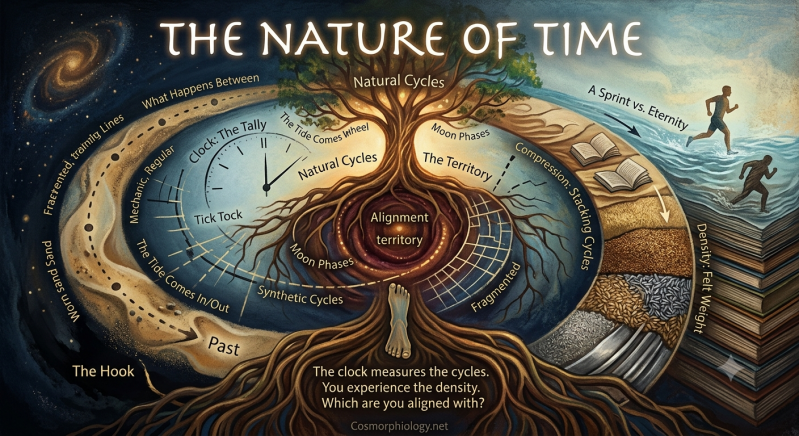
The Territory
The tide comes in. The tide goes out.
The day turns. The night falls.
The seasons wheel. The moon phases. The year completes.
These things happen.
Not because you believe in them.
Not because you pay attention to them.
Not because you acknowledge them.
They were here before you arrived.
They will be here after you leave.
Your acknowledgment is irrelevant.
Your belief is unnecessary.
Your attention is optional.
They simply are.
That's the territory.
The Tally
We count these cycles. We chop them into smaller bits. We call it time.
Tick. Tock. One cycle. Another cycle. Another.
The clock counts the returns.
It does not measure what happens between them.
What Happens Between
Each cycle returns. But it does not return to the same place.
Something shifts. Something accumulates. Something thickens.
The grain of sand is rounder.
The cake is baked.
The book read ten times lives differently than the book read once.
The cycle closes, but the substrate has shifted.
Compression is not time.
Compression is what happens when cycles stack.
The Felt Weight
Now place yourself inside this.
Some days stretch. Some days vanish.
The clock says the same. You know it's different.
Read one book in an hour. Then try to read two hundred.
The clock says the same. You know it's different.
Run on the beach. Then run in the ocean.
The distance is the same. The clock says the same.
One feels like a sprint. The other feels like eternity.
When time feels full—packed, dense, like it contains more than it should—what does that feel like?
When time feels empty—thin, weightless, like it's slipping through your fingers—what's different about that?
The clock measures the cycles.
You experience the density per cycle.
The Distinction
Science measures the tally of cycles. It calls this time.
But the tally is not the compression.
The tide returns. The sand is rounder.
The day returns. You are older.
The year returns. The mountain is worn.
There are cycles that are natural. They stack. They deepen. They densify.
There are cycles that are not natural. They fragment. They thin. They don't hold the same weight.
The clock measures them all the same.
That is the distinction.
The Return
The tide moves. Not because you watch it.
The day turns. Not because you count it.
The seasons wheel. Not because you name them.
The heart beats. The lungs breathe. The eyes blink.
These things happen.
Not because you make them.
Because they're already running.
You've been living inside these rhythms your whole life.
Are you coupled to the natural ones?
Or the synthetic ones?
That's the real question.
The Core
Static cannot remain static.
It moves through least resistance.
Least resistance spirals.
Spirals create cycles.
Cycles stack.
Stacking creates compression.
Compression densifies or fragments.
Time is the measure of nested cycles.
Cycles within cycles.
The clock measures the tally.
You feel the density per cycle.
Natural cycles stack and deepen.
Synthetic cycles fragment and thin.
One is the tally.
The other is the territory.
Both are real.
They are not the same.
Which cycles are you coupled to?
© 2025 Dylan Cameron. All Rights Reserved.
Cosmorphiology.net