THE ILLUSION OF FREE WILL
IS FREE WILL AN ILLUSION?
We are often told that free will must be one of two things.
Either we are completely free: infinite choice, unlimited possibility, the ability to choose anything at any moment.
Or everything is predetermined: every thought, decision and action was always going to happen, and what we experience as choice is simply the unfolding of destiny.
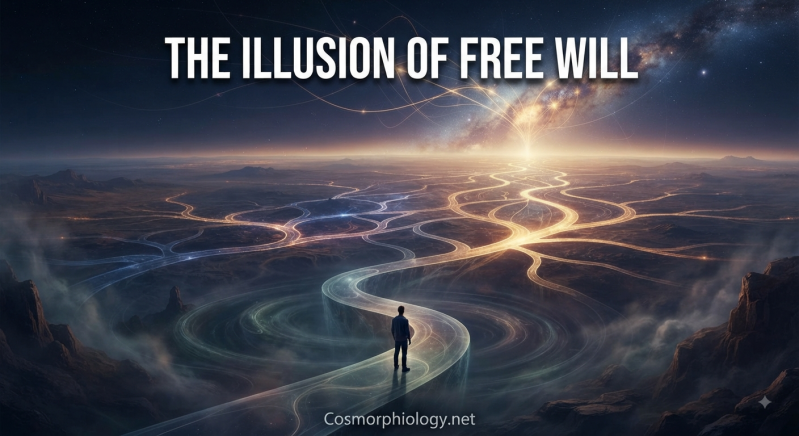
WHAT IF BOTH EXTREMES ARE WRONG?
What if free will exists—not as absolute freedom from all constraints, but as the capacity to select and influence pathways within the constraints of reality?
To investigate this, we first need to distinguish between possibility, probability and inevitability.
Possibility is what can happen.
Probability is what is likely to happen.
Inevitability is what cannot not happen, given the conditions.
Life seems to operate across all three.
ABSOLUTE FREEDOM CANNOT EXIST
Absolute free will would mean being able to become or do anything whatsoever, independently of biology, environment, history, physical laws, capacity or circumstance.
But genuine constraints exist.
You cannot decide to become something you fundamentally are not simply by willing it.
Meditating on a rock for twenty years does not turn you into a rock, even if you develop profound empathy for stillness.
Dreaming of flying like a bird does not produce wings.
You cannot decide to breathe underwater indefinitely without equipment. You cannot choose to remember a conversation you never experienced. You cannot decide that gravity will stop applying to you because you disagree with it.
Even within ordinary human life, our possibilities are constrained.
A person born without access to a particular language cannot spontaneously speak it fluently without first encountering and learning it. Someone with no money cannot exercise the same immediate economic choices as someone with enormous wealth. Someone living in a desert does not have the same environmental options as someone living beside an ocean.
Biology constrains us.
Environment constrains us.
Knowledge constrains us.
Time constrains us.
Social dynamics constraint us.
Our nervous system constrains us.
Our habits, conditioning, fears, desires and current state of awareness constrain us.
Even our physical location constrains us.
This does not necessarily mean we have no freedom.
It means freedom operates inside a field of constraints.
INFINITE CHOICE IS NOT FREEDOM EITHER
The idea of infinite options sounds liberating, but an infinite field of choices can become practically useless.
Imagine standing in a room containing a million possible objects and being told:
"Choose anything."
Where do you begin?
Too many possibilities can produce indecision, paralysis and dispersion.
The same thing happens psychologically.
When every pathway appears equally important, it becomes difficult to commit to any pathway at all.
And choices are never actually presented in a vacuum.
If you live in an area that does not produce or supply something, that option may technically exist somewhere in the world, but it is not an immediate viable pathway within your environment.
If you are hungry, tired and exhausted, your decision-making field changes.
If you have spent ten years practicing an instrument, the pathways available to you are different from those available to someone who has never touched one.
Your history changes your present possibility space.
So perhaps free will is not the ability to choose from infinite possibilities.
Perhaps it is the ability to navigate the possibilities that actually exist within your current field.
We do not choose from everything.
We choose from what is accessible, perceivable, imaginable, biologically possible and psychologically available to us.
BUT IS EVERYTHING PREDETERMINED?
The opposite position says that if our choices are constrained by biology, environment and causality, then they must be predetermined.
But constraints are not necessarily conclusions.
A river has banks, but the banks do not dictate every movement of every molecule of water.
A road constrains where a car can travel, but there can still be multiple exits, turns and destinations.
A habit creates a strong pathway, but a strong pathway can be interrupted.
Someone who has smoked for twenty years can quit.
Someone who has always avoided conflict can learn to have difficult conversations.
Someone who has lived in poverty can build wealth.
Someone who has always been sedentary can begin exercising.
Someone who has repeatedly reacted with anger can learn to pause.
The previous pathway can influence the next pathway without permanently determining it.
This distinction is important.
Probability is not inevitability.
A person with a strong tendency toward a particular behaviour is more likely to repeat it. But "more likely" does not mean "cannot do otherwise."
And this is where genuine choice becomes interesting.
Choice may not mean escaping causality.
Choice may mean participating in causality.
ENERGY MOVES THROUGH THE PATH OF LEAST RESISTANCE
Imagine reality as a network of pathways.
Energy moves through those pathways. Whether you've decided or not.
Some pathways are wide and well-established. Others are narrow and difficult to access. Some converge. Some diverge. Some disappear entirely.
A thought is a pathway.
A habit is a pathway.
A relationship is a pathway.
A skill is a pathway.
A belief is a pathway.
A repeated action strengthens a pathway, making it easier to travel again.
This pattern appears everywhere.
The first time you drive somewhere unfamiliar, every turn requires conscious attention. After driving the route repeatedly, the pathway becomes familiar. Eventually you can travel it with very little conscious effort.
The same thing happens inside us.
Repeated thoughts become easier to think.
Repeated emotional responses become easier to trigger.
Repeated behaviours become habits.
Repeated habits become patterns.
Patterns can eventually feel like destiny.
But a pathway being well-established does not mean it is the only pathway.
It means energy has been conditioned to flow there.
THE CONVERGENCE
Now consider what happens when multiple pathways converge.
You decide to become healthier.
You begin exercising.
You improve your diet.
You sleep better.
You drink less alcohol.
You spend more time outside.
You manage your stress.
You repeat these behaviours for months.
Each individual behaviour influences the outcome.
But something more interesting happens when they converge.
The pathways reinforce one another.
It becomes increasingly difficult for the outcome not to occur.
Try consistently exercising, eating nutritious food, sleeping adequately and taking care of your body—and then try not to experience some improvement in fitness and health.
The result is not mathematically guaranteed in every individual case. Biology is complex and exceptions exist.
But you have dramatically shifted the probability landscape.
You have constrained the pathways.
You have made certain outcomes easier to reach and others harder to reach.
This is the pattern.
A student who studies consistently, attends class, asks questions, practices deliberately and seeks feedback is not guaranteed to become excellent.
But the convergent pathways make improvement increasingly probable.
A person who repeatedly puts themselves in environments where meaningful relationships can form, develops social skills, communicates openly and treats people well is not guaranteed to find love.
But they have changed the pathway landscape.
They have made certain outcomes harder not to encounter.
The beach and the storm
Consider something simple.
You want to go to the beach and get a tan.
Under ordinary conditions, walking to the beach is a pathway toward that outcome.
But then a storm arrives.
The environment changes.
The pathway is disrupted.
You may still go to the beach, but the probability of getting the desired result changes dramatically.
The objective remains the same.
The environment has changed.
This is why intention alone is insufficient.
You cannot simply choose the outcome.
You choose—or influence—the pathways leading toward the outcome.
And those pathways exist inside conditions.
This is why "positive thinking" by itself is often so weak.
Thinking about the beach does not move you toward the beach.
Walking toward it does.
Having the intention to become fit does not produce fitness.
Training does.
Wanting to become financially secure does not create financial security.
The behaviours, skills, relationships, opportunities and decisions that converge toward it do.
ALL RIVERS LEAD TO THE OCEAN
There is an old idea that all rivers eventually lead to the ocean.
Perhaps life has something similar.
Certain pathways converge.
Different routes can produce similar destinations.
But the route still matters.
Walking to the beach and driving to the beach may eventually produce the same destination, but they involve different experiences, risks, costs and consequences.
Choosing one pathway changes what happens along the way.
And sometimes the destination changes too.
A single decision can create a new branch.
A new relationship introduces new possibilities.
A new skill creates new possibilities.
A new environment creates new possibilities.
A new habit creates new possibilities.
A new piece of information can reorganize the entire decision landscape.
The future therefore may not be a blank canvas.
But neither does it have to be a stone tablet.
It may be a landscape of constrained pathways.
THE PHI METHOD
There is a method to the madness. A system of converging constrained pathways.
Not wishful thinking.
Not pretending everything will work out.
Not forcing yourself to "stay positive."
The principle is much simpler:
Align enough convergent pathways toward an outcome that the probability of that outcome increasesingly becomes harder to not happen.
Instead of asking, "How do I make this happen?"
Ask:
"What pathways would make this hard to NOT happen?"
Then build those pathways.
If you want better health, what behaviours converge toward it?
If you want stronger relationships, what environments and behaviours converge toward them?
If you want to learn something, what pathways repeatedly expose you to information, practice and feedback?
If you want to change a habit, what conditions make the new behaviour easier and the old behaviour harder?
It's not commanding reality.
It's shaping the conditions through which reality unfolds for you.
And perhaps that is where free will actually lives.
Not in infinite choice.
Not outside causality.
Not in escaping every constraint.
But in the capacity to recognize pathways, influence conditions, choose directions and strengthen convergence.
Some things cannot happen.
Some things are highly unlikely.
Some things are almost inevitable.
And between those boundaries lies a field of genuine possibility.
So look around you.
WHAT PATHWAYS ARE ALREADY IN YOUR MIDST?
Which ones are carrying you somewhere you actually want to go?
Which ones are being strengthened simply because you keep travelling them?
And which new pathways could you begin building today?
Because the future may not be something waiting to be discovered.
It may be something continuously shaped by the pathways through which we move.
---
© 2025 Dylan Cameron. All Rights Reserved.
Cosmorphiology.net